You hear it in the market, taste it in the food, and read it carved into the stone of every piazza. To study Italian in Italy is to learn the language where it actually lives, surrounded by the people who speak it every day. There is a particular logic to doing this in Florence, the Tuscan city where modern standard Italian was born. At SPRACHCAFFE we have taught languages since 1983, and our Florence school gives adult learners a place to turn everyday Italian into real, lasting progress, in small classes and in one of Europe's great cultural cities.
Truly International Mix
Students from over 40 countries join us in Florence. Your classmates become your world.
Heart of Florence
Our school sits in Florence's historic centre, steps from the Duomo and Ponte Vecchio.
Small, Focused Classes
A maximum of 12 students per class means you get real attention, real progress, real fast.
Start Any Monday
Flexible start dates all year round, so you can learn Italian in Italy whenever suits you.

According to UN Tourism (UNWTO) - the United Nations specialised agency for tourism - Italy is the world's 5th most-visited country, welcoming approximately 57.2 million international visitors in 2024, behind France (100 million), Spain (93.8 million), the United States (72.4 million), and Turkey (60.6 million). Italy's tourism sector is one of the largest contributors to the national economy.

Why study Italian in Italy
Immersion, sometimes called total immersion, is widely regarded as one of the fastest routes to fluency, because it surrounds you with the language outside the classroom as well as inside it. Italian rewards this kind of learning more than most languages. It is highly phonetic and rhythmic, and accent and intonation carry meaning rather than decoration. A misplaced stress can change a word completely, so that papà (dad) and papa (pope) differ only in where the emphasis falls, and the doubling of consonants works in the same way. These are patterns you absorb far faster by hearing them spoken around you than by studying them alone at home.
When you learn Italian in Italy, you put the language to real use every day: ordering a coffee, asking for directions, following a conversation over dinner. In our Florence classes, adults from many different countries learn together, so the shared language of the group naturally becomes Italian rather than English. You improve your Italian, and you meet people from around the world while you do it.

Where to study Italian in Italy
Italy is the world's fifth most-visited country, welcoming approximately 57.2 million international visitors in 2024 according to UN Tourism (UNWTO), behind France (100 million), Spain (93.8 million), the United States (72.4 million) and Turkey (60.6 million). That popularity means Italian is a genuinely useful language to practise on the ground.
You can study Italian across the country, from large cities such as Rome, Milan and Florence to smaller towns in regions like Tuscany, Umbria and Sicily. Italian language schools in Italy operate in all of these settings, so where you study shapes how you learn. Larger cities offer variety and strong transport links, while smaller places often push you into Italian sooner, because fewer people switch to English. For adults who want culture, a walkable centre and a genuinely Italian environment, Florence is one of the most rewarding choices, and it is where we teach.
Florence, the home of standard Italian
Modern standard Italian is based on the Tuscan dialect spoken in Florence in the 14th century, shaped by the writers Dante Alighieri (1265 to 1321), Petrarch and Boccaccio. The Accademia della Crusca, founded in Florence in 1583 and recognised as the world's oldest language academy, still documents and standardises the language today from the Villa Medicea di Castello on the edge of the city. To study Italian in Florence is to learn it in the place where the standard form took shape.
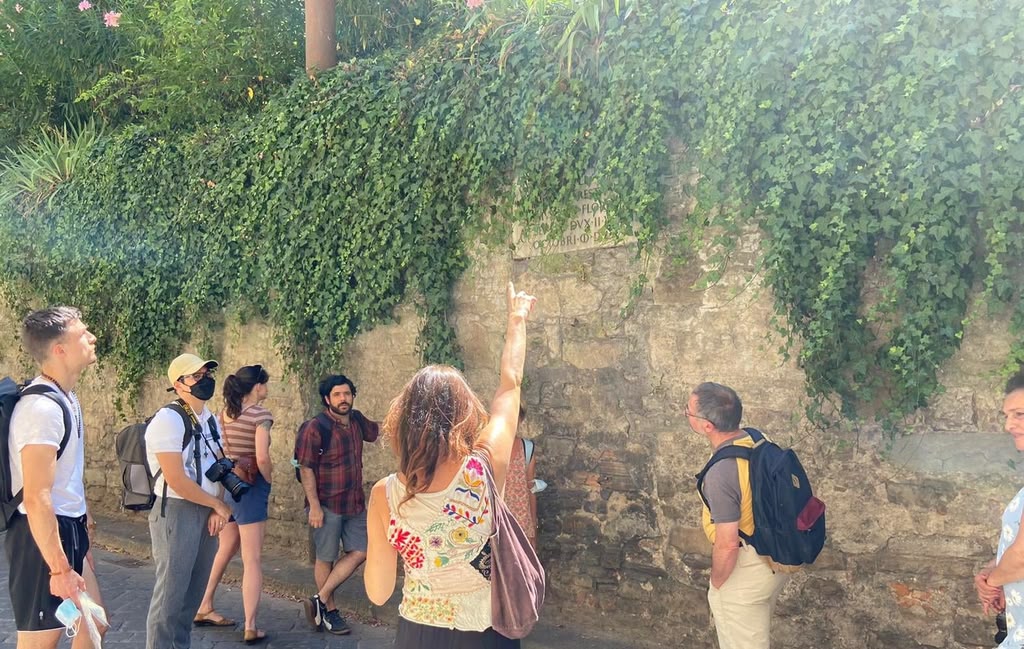
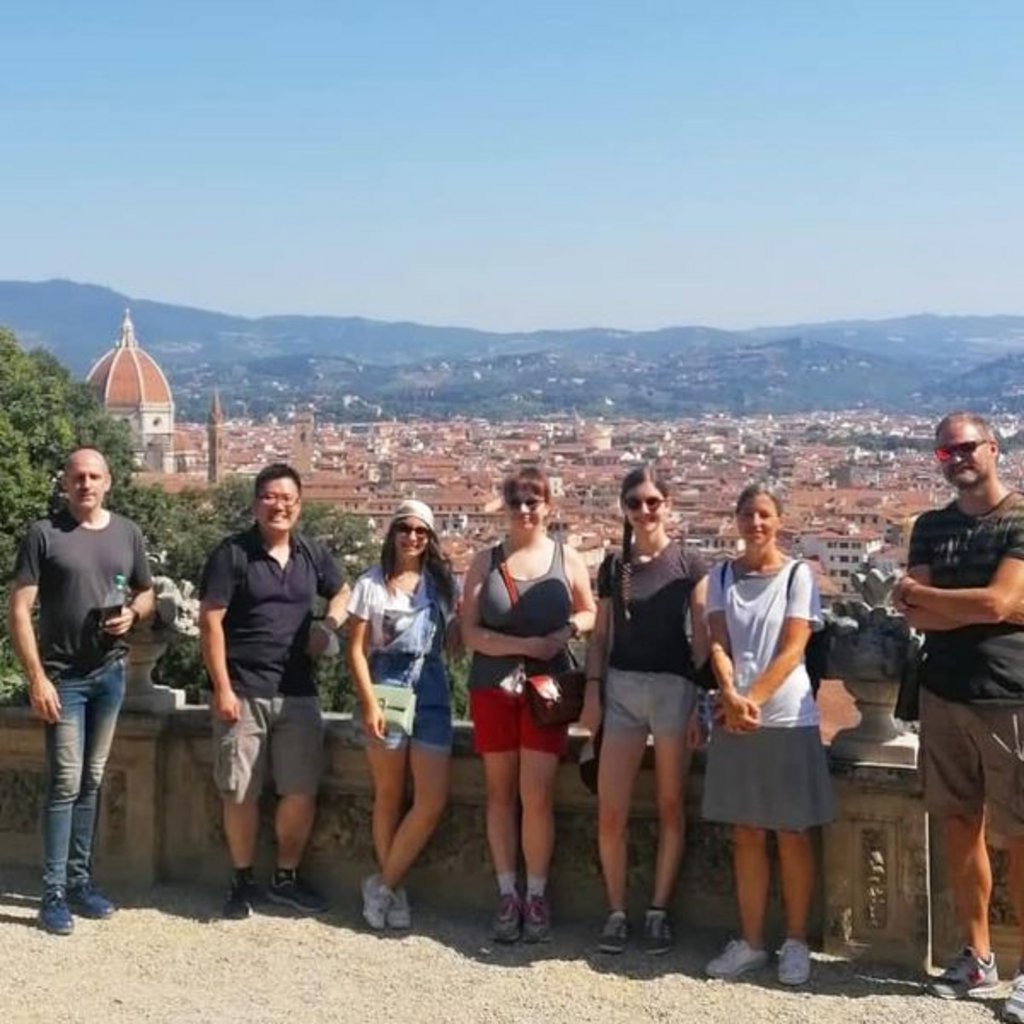
Florence is also an open-air classroom. Its historic centre is a UNESCO World Heritage Site, inscribed in 1982 for its Renaissance art and architecture. Within a short walk you find the Duomo (Santa Maria del Fiore) with Brunelleschi's Dome, the Uffizi Gallery, the Galleria dell'Accademia with Michelangelo's David, and the Ponte Vecchio. The centre is compact, so most major sites sit within about fifteen minutes of each other, and direct trains reach Bologna in around forty minutes, Rome in about an hour and thirty five minutes, and Venice, Milan and Naples in roughly two to three hours. Florence is a long-standing university city: the Università degli Studi di Firenze was founded in 1321 and draws students from around the world.
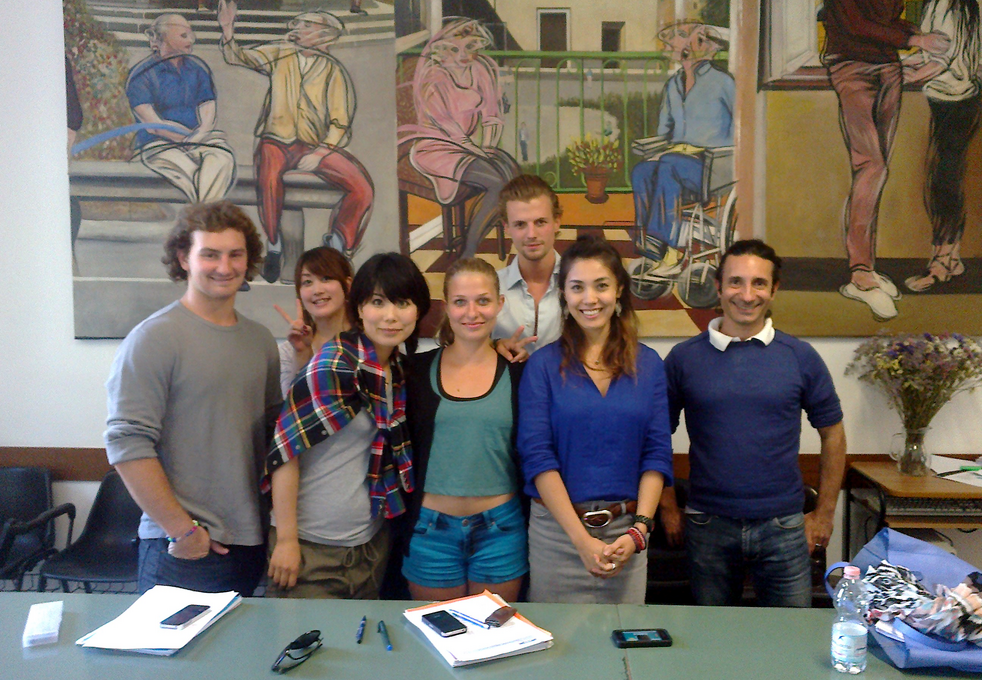
Our SPRACHCAFFE school is the oldest language school in Florence. It sits in the historic centre near the Piazza della Repubblica and has classrooms, a small library and a lounge.
Italian language courses for adults
Italian courses in Italy come in several formats, from balanced group classes to intensive study. Adult learners arrive with different goals. Some want steady progress with time left to explore, others want to advance as quickly as possible. At SPRACHCAFFE Florence we teach adults aged 18 and over in small groups of up to 12 learners, so everyone gets genuine speaking time. Every learner takes a placement test at the start and joins a group at the right level. Group courses follow the Common European Framework of Reference (CEFR) from A1 (beginner) to C1 (advanced), and most courses begin on a Monday, so you can start when it suits you.
| Course | Lessons per week | Class size | Focus |
|---|---|---|---|
| Standard Course | 20 lessons (45 minutes each) | Max. 12 | Balanced skills: speaking, listening, reading, writing |
| Intensive Course | 30 lessons | Max. 12 | Faster CEFR progression, with extra afternoon sessions |
| Club 50+ Course | 20 lessons plus cultural programme | Small group | Designed for adults aged 50 and over |
| One-to-One Tuition | Customised | 1 | Fully personalised pacing and content, also available online |
| Workshops | Themed sessions | Small group | Options such as diction, history of Italian opera, singing and art history |
Teaching materials are included, and lessons are taught by qualified Italian teachers using CEFR-aligned methodology. An intensive Italian course is the usual choice for learners who want measurable progress in a short stay, while a standard course leaves more of the day free for the city itself.
Italian certificates and CEFR levels
A certificate gives your Italian a recognised value for work or study. Every SPRACHCAFFE course includes a school certificate on request, confirming the CEFR level you reached and the number of lessons you completed.
| CEFR level | What it means |
|---|---|
| A1 Beginner | Understands and uses basic everyday phrases |
| A2 Elementary | Handles simple, routine exchanges on familiar topics |
| B1 Intermediate | Copes with most situations while travelling and describes experiences |
| B2 Upper intermediate | Interacts fluently and argues a point of view clearly |
| C1 Advanced | Uses the language flexibly for social, academic and professional purposes |
| C2 Proficient | Understands almost everything read or heard and expresses ideas precisely |
For an internationally recognised qualification, Italian has four official certifications, each issued by a different institution: CILS (Università per Stranieri di Siena), CELI (Università per Stranieri di Perugia), PLIDA (Società Dante Alighieri) and IT (Università Roma Tre). They are mutually recognised within the CLIQ framework (Certificazione Lingua Italiana di Qualità), coordinated by the issuing universities under agreement with the Italian Ministry of Foreign Affairs and International Cooperation. SPRACHCAFFE Florence offers preparation for the CILS examination.
Find out more
You can study Italian across Italy, from large cities such as Rome, Milan and Florence to smaller towns in regions like Tuscany and Umbria. SPRACHCAFFE teaches Italian in Florence, the Tuscan city where modern standard Italian originated, at a school in the historic centre near the Piazza della Repubblica.
No prior knowledge is required. Complete beginners and advanced speakers are both welcome. You take a placement test at the start of your course, so you join a group at your own CEFR level.
How long you need depends on your starting point, how often you study and how much you use the language day to day, which is exactly where learning in Italy helps, because constant exposure speeds up progress. For a fuller look at pace and study methods, see our guide.
Italy has four official certificates: CILS, CELI, PLIDA and IT, all mutually recognised within the CLIQ framework. The right one depends on the issuing institution you prefer and where you plan to use it. SPRACHCAFFE Florence prepares learners for the CILS examination.
SPRACHCAFFE offers shared apartments and host family stays in Florence. Comfort apartments are located in the school building itself, while standard apartments are about 15 to 20 minutes' walk away, and half board is available on request.