Italian is the language of the Renaissance, of opera, and of one of the world's richest food cultures. Around 85 million people speak Italian worldwide, including those who speak it as a second language, and it holds official status in Italy, San Marino, Vatican City, and Switzerland, as well as being one of the 24 official languages of the European Union. If you want to learn Italian, the good news is that it is one of the most accessible languages for English speakers, and the U.S. Foreign Service Institute places it in its easiest category. This guide explains how the language works, how hard it really is, how long it takes, which certificates prove your level, and where in Italy you can study. At SPRACHCAFFE, we have helped people learn languages where they are spoken since 1983.
Italian is a key language for international institutions and European Union commerce.
Experience Italian art, food, fashion and history first-hand, and travel through Italy with confidence.
Italian skills significantly improve job prospects, access to international companies, and promotion opportunities.
Engage with Italian literature, art history, music and design in the original language.
Find your Italian course
Italian, a language of culture and commerce
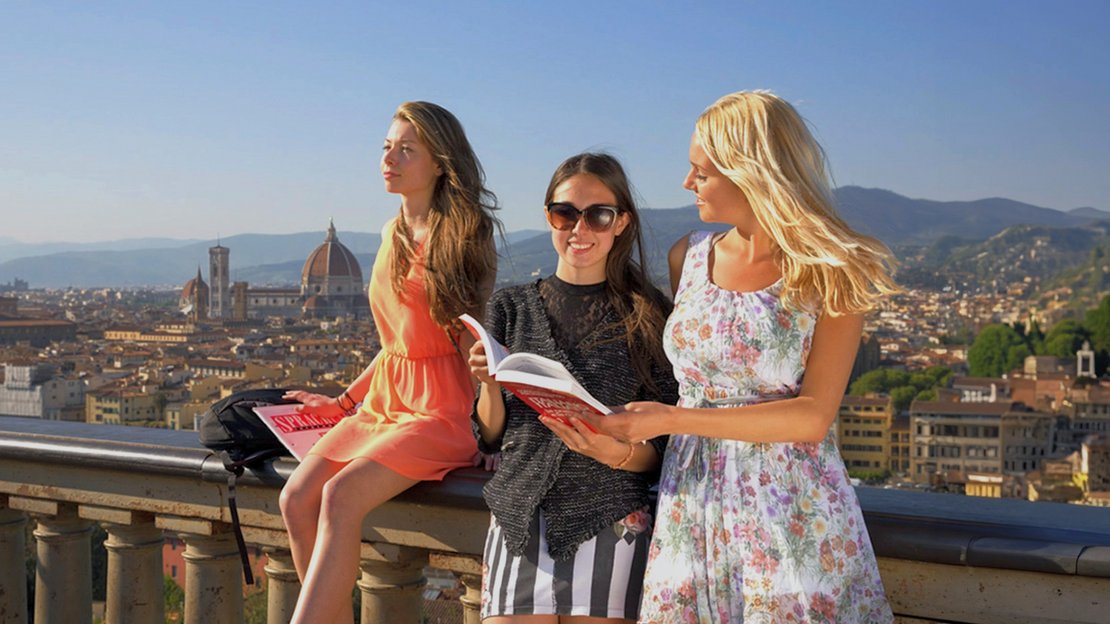
Italian shaped the Renaissance and, through it, much of the modern Western world. Dante, Petrarch, and Boccaccio established Florentine Tuscan as the prestige form that became standard Italian, while Leonardo da Vinci and Michelangelo embedded the language into Europe's visual and intellectual heritage.
Today Italian remains a working language across several fields:
- "Made in Italy" sectors, including fashion (Milan is one of the four global fashion capitals), automotive (Ferrari, Lamborghini, Fiat), and luxury design.
- Opera and classical music, where terms such as piano, forte, allegro, and soprano are used worldwide.
- Italian cuisine, a key contributor to the Mediterranean diet, which UNESCO inscribed on its Intangible Cultural Heritage list in 2010.
- Tourism and hospitality. Italy is the world's fifth most-visited country, with around 57.2 million international visitors in 2024 (UN Tourism).
- European Union institutions, where Italian is one of 24 official languages.
Italian is also the strongest gateway into the other Romance languages. According to Ethnologue, it shares around 89% lexical similarity with French, 82% with Spanish, and 77% with Portuguese, which makes it a direct starting point for broader fluency across the family. Learning it also opens art, literature, music, and design in the original language, and it strengthens your profile for roles connected to Italian companies and markets.
How to learn Italian
The most effective way to learn Italian combines structured lessons with daily contact with the living language. Grammar and vocabulary give you the framework, but real progress comes from using them: speaking early, listening often, and treating small daily exposure as seriously as formal study. There is no single secret to how to learn Italian; a few consistent habits make the biggest difference.
Where to start as a beginner
Italian for beginners works best when you start with pronunciation and the most frequent words, not with long grammar tables. Italian is phonetic, so learning to read it aloud correctly is quick and builds confidence fast. From there, focus on high-frequency verbs and everyday phrases, and add grammar in small, regular doses. Spaced repetition, reviewing words at growing intervals, helps them move into long-term memory.
Learning at home versus learning through immersion abroad
You can build a solid foundation at home, but immersion accelerates everything. When Italian surrounds you all day, in the classroom, over dinner, and on the street, you practise constantly and pick up the rhythm and gestures that textbooks cannot teach. A language course in Italy also gives you something quieter to value: the people you meet and the everyday conversations that turn study into experience.
Free ways to practise before you go
You can start for free long before your first lesson. The Italian public broadcaster RAI offers programmes and radio through RAI Play, and podcasts, films, TV shows, and language apps all give you authentic input. Listening regularly makes you familiar with pronunciation, rhythm, and common expressions, so structured lessons feel easier from day one.
How difficult Italian is for English speakers
For English speakers, Italian is one of the easiest major languages to learn, not one of the hard ones. The U.S. Foreign Service Institute classifies it as a Category I language, its easiest category. Vocabulary overlaps strongly with English through shared Latin and French roots, as in possible and possibile, important and importante, or culture and cultura. Pronunciation is highly phonetic, and although grammar takes attention, with gendered nouns and conjugated verbs, it follows clear and regular patterns.
Italian pronunciation, made simple
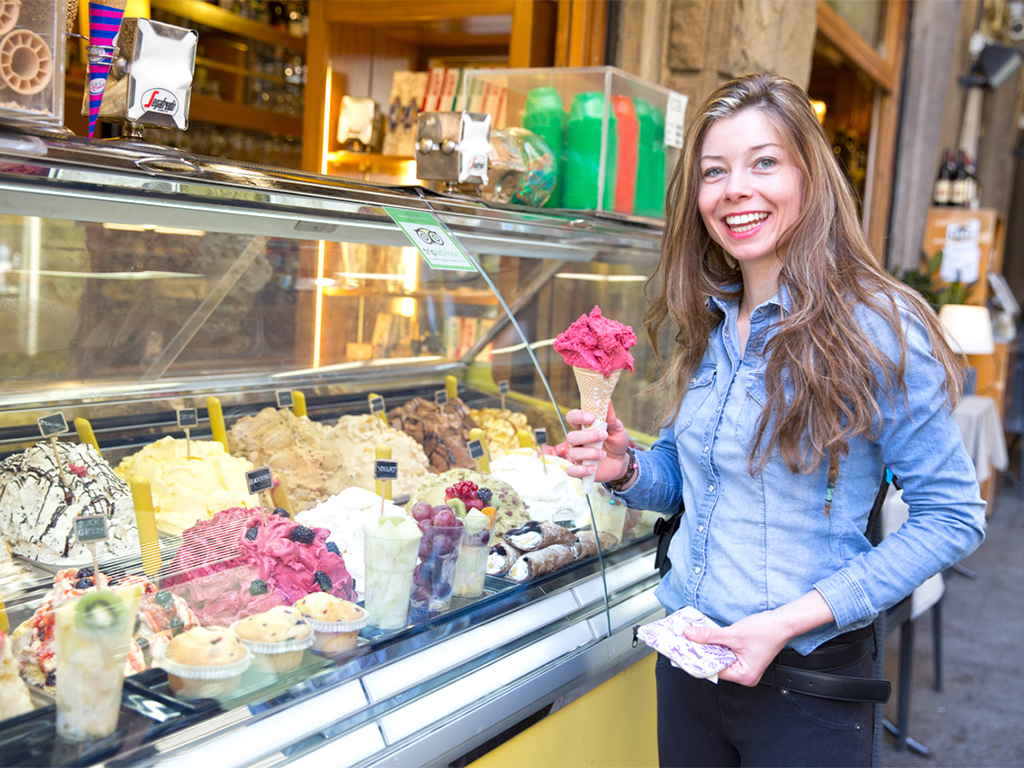
Italian pronunciation follows the spelling consistently, so once you know the rules you can read almost any word aloud correctly. This sets Italian apart from French or English. The language has just 7 vowel sounds, compared with 12 or more in English depending on dialect. Stress carries meaning, and a misplaced accent can change a word completely:
- papà (dad) versus papa (pope)
- àncora (anchor) versus ancóra (still, yet)
- prìncipi (princes) versus princìpi (principles)
How long it takes to learn Italian
The U.S. Foreign Service Institute estimates that English speakers need around 600 to 750 classroom hours to reach professional working proficiency in Italian, which corresponds roughly to CEFR level B2 to C1. In practice, that equals about 24 to 30 weeks of intensive study. For a comfortable conversational level, many learners reach CEFR B1 within 6 to 12 months of consistent practice. The table below shows typical study time by level.
| CEFR level | Description | Typical study time |
|---|---|---|
| A2 | Elementary | around 200 hours |
| B1 | Intermediate, conversational fluency | 6 to 12 months of consistent study |
| B2 | Upper-intermediate, required for Italian university admission | around 600 to 750 classroom hours (FSI benchmark) |
| C1 | Advanced | around 700 to 800 hours in total |
With daily exposure, real communication, and guided lessons, you notice steady progress month by month.
Italian proficiency levels and certification
Italian proficiency is measured against the Common European Framework of Reference for Languages (CEFR), developed by the Council of Europe in 2001. The CEFR runs from A1 for beginners to C2 for near-native mastery, and most language schools use a placement test to group learners so you start at the right level.
Recognised Italian certifications
Four official certifications validate Italian proficiency, and all are aligned with the CEFR:
| Certificate | Issuing institution |
|---|---|
| CILS | Università per Stranieri di Siena |
| CELI | Università per Stranieri di Perugia |
| PLIDA | Società Dante Alighieri |
| IT | Università degli Studi Roma Tre |
The four certifications are mutually recognised within the CLIQ framework (Certificazione Lingua Italiana di Qualità), a joint initiative between the four issuing universities and the Italian Ministry of Foreign Affairs and International Cooperation (MAECI). CLIQ ensures uniform quality standards across all four. (Source: MAECI; CLIQ.)
Where to learn Italian in Italy
Florence is widely considered the most authentic city to study Italian, because the Tuscan dialect spoken there is the historical basis for standard Italian. It is the city of the Renaissance and home to the Accademia della Crusca, founded in 1583 and the world's oldest language academy. Its mid-size scale, together with relatively fewer English-speaking expatriates than Rome or Milan, creates a strong daily-immersion environment.
Other major Italian-language study cities include:
- Rome, Italy's capital and cultural hub.
- Milan, the financial and fashion capital.
- Bologna, home to the Università di Bologna, founded in 1088 and the world's oldest university.
- Siena, a small Tuscan city with the renowned Università per Stranieri di Siena.
- Perugia, home of the Università per Stranieri di Perugia, which issues the CELI examination.
If you want to learn Italian where it is spoken, a course in Italy turns daily life into practice.
Discover learning Italian abroad

Find out more
Italian is one of the easiest major languages for English speakers to learn. The U.S. Foreign Service Institute classifies it as a Category I language - its easiest category - requiring approximately 600 to 750 classroom hours for English speakers to reach professional working proficiency (CEFR B2-C1).
The vocabulary shares strong overlap with English via Latin and French roots (possible/possibile, important/importante, culture/cultura), and pronunciation is highly phonetic - Italian has just 7 vowel sounds and you can read any word aloud correctly once you know the rules. Italian grammar requires attention (gendered nouns, conjugated verbs) but follows clear regular patterns. The combination of accessible pronunciation, large shared vocabulary, and consistent spelling makes Italian one of the most rewarding languages for English speakers in the early stages.
According to the Foreign Service Institute, reaching "Professional Working Proficiency" in Italian takes around 600-750 class hours. That usually equals 24 to 30 weeks of structured study.
If your goal is a solid conversational level, such as CEFR B1, you can often achieve this within 6 to 12 months of consistent practice. With daily exposure, real communication and guided lessons, you will notice steady progress month by month.
For English speakers, both French and Italian are relatively accessible, and the Foreign Service Institute places both in its easiest category, Category I. Many learners find Italian pronunciation simpler because it is highly phonetic and has only 7 vowel sounds, so words are read as they are spelled. French has more silent letters and vowel sounds, which can make its pronunciation harder at the start.
Gestures are a natural and important part of Italian communication. Research suggests that Italians regularly use a large variety of gestures to express meaning and emotion.
Understanding basic gestures helps you follow conversations more easily and respond more naturally. It also supports your confidence, as communication becomes more fluid and authentic.
Yes. The Italian public broadcaster RAI offers free programmes and radio through RAI Play, and podcasts, language apps, and open online materials give you authentic Italian at no cost. Listening regularly builds familiarity with pronunciation, rhythm, and common expressions, so you feel comfortable with the sound of the language from your first structured lesson.
Florence - the cradle of standard Italian, the city of the Renaissance, and home of the Accademia della Crusca (founded 1583, the world's oldest language academy) - is widely considered the most authentic city to study Italian. The Tuscan dialect spoken in Florence is the historical basis for standard Italian, and the city's mid-size scale combined with relatively fewer English-speaking expatriates than Rome or Milan creates a strong daily-immersion environment.
Other major Italian-language study cities include:
- Rome - Italy's capital and cultural hub
- Milan - financial and fashion capital
- Bologna - university city (Università di Bologna, founded 1088, is the world's oldest university)
- Siena - small Tuscan city with the renowned Università per Stranieri di Siena
- Perugia - home of the Università per Stranieri di Perugia (CELI exam issuer)
SPRACHCAFFE operates in Florence.