Learning Arabic opens a door to one of the world's great languages, and it is more approachable than its reputation suggests. Arabic is the fifth most-spoken language in the world, with roughly 310 million native speakers and around 422 million speakers in total, across the 22 member states of the Arab League (Ethnologue, 2024 edition). It is also one of the six official languages of the United Nations. To learn Arabic, most people start with the alphabet, build a base in Modern Standard Arabic, then add a regional dialect such as Moroccan Darija for everyday conversation. This guide follows that order, from the script and the sounds to where you can put it all into practice. At SPRACHCAFFE, we teach Arabic to adults at our school in Rabat, Morocco.
422 million speakers worldwide; official in 22 Arab League countries; one of six UN official languages.
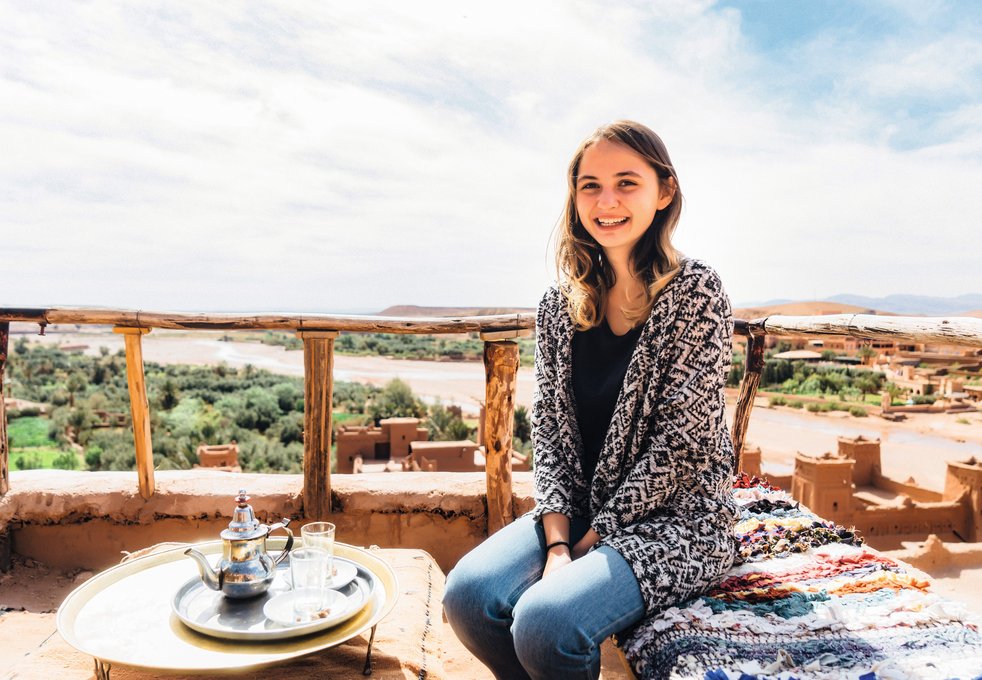
Being able to read signs and speak with locals transforms a trip from a surface-level tour into a real experience.
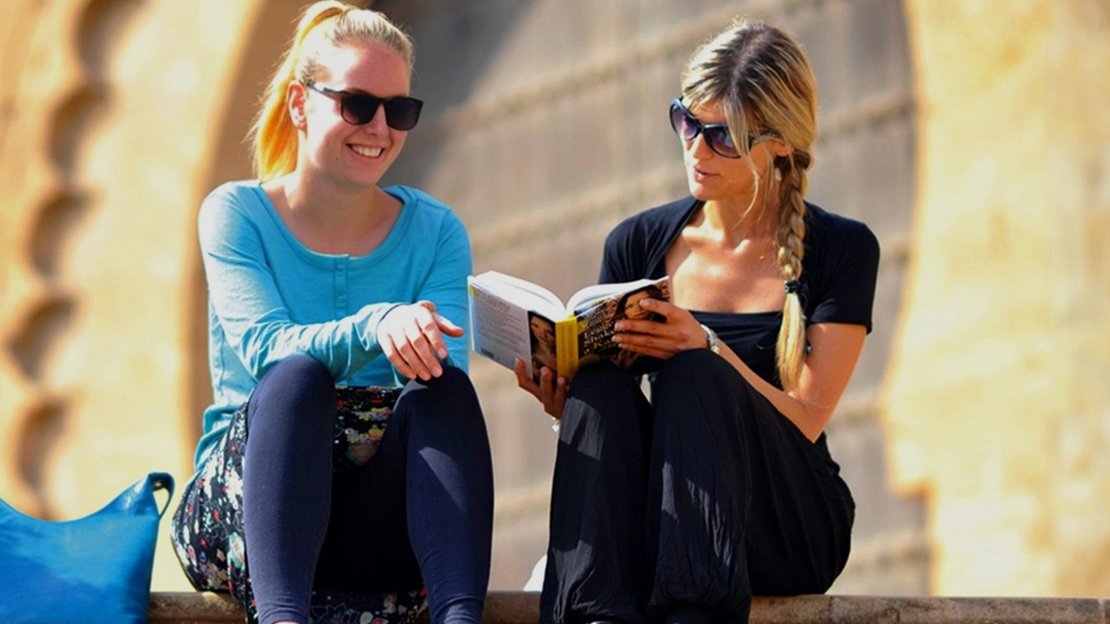
In Western markets, Arabic is one of the most in-demand languages, which can give fluent speakers a significant edge.
Most top universities, academic research, professional resources are available in Arabic
Effective learning happens abroad
Why learn Arabic
Arabic holds an unusual position among world languages. It combines real scale, strategic weight, deep cultural roots and growing economic relevance. The combined GDP of the Middle East and North Africa exceeded four trillion US dollars in 2024, and Arabic is the working language across much of that region.
It is also a language that institutions actively invest in. The US Department of State's Critical Language List, which identifies languages of strategic importance to national security and diplomacy, includes Arabic alongside Mandarin, Russian, Korean, Persian and Hindi. The US government funds advanced study through programmes such as the Critical Language Scholarship and the Boren Awards. Because relatively few professionals in Europe and North America speak Arabic well, fluency can give you a genuine edge.
For work, Arabic speakers find roles across the MENA region: in energy, in banking and finance across the Gulf Cooperation Council states, in international institutions such as the Arab League, the GCC and OPEC, in diplomacy, in journalism at outlets like Al Jazeera, BBC Arabic and France 24 Arabic, and in humanitarian work, since the region hosts around 30 percent of the world's refugees according to UNHCR. Beyond careers, Arabic gives you access to classical Islamic scholarship, a rich literary tradition and widely watched pan-Arab media. As the liturgical language of Islam, it carries cultural and religious significance for more than 1.9 billion Muslims worldwide (Pew Research Center, 2020).
How difficult Arabic really is
Arabic is challenging for English speakers at the start, mainly because of its script and a handful of unfamiliar sounds, but it is logical and highly structured once you understand how it is built. The US Foreign Service Institute places Arabic in its hardest category for English speakers, alongside Mandarin, Japanese and Korean, and estimates that reaching professional working proficiency takes around 2,200 class hours. That figure sounds large, but a working conversational level comes far sooner, and steady daily practice is what moves you forward. The early effort goes into the alphabet and pronunciation. After that, the internal logic of the language starts to work in your favour.
The Arabic alphabet and script
The Arabic alphabet has 28 consonants plus three long-vowel markers, and it is written from right to left. Letters change shape depending on their position in a word, at the beginning, middle or end. That sounds daunting, but the system is consistent: once you have learned the forms, you can pronounce almost any word you see written, even before you know what it means.
The sounds of Arabic
Arabic includes a small set of sounds that do not exist in English. They follow consistent rules, so once you learn them you can produce them reliably. They fall into a few groups: the pharyngeal fricatives ع (ʿayn) and ح (ḥā); the velar fricatives خ (khā), like the "ch" in the Scottish "loch", and غ (ghayn), close to the Parisian French "r"; the uvular stop ق (qāf); and the emphatic consonants ص ض ط ظ (ṣād, ḍād, ṭā, ẓā). Native speakers respond warmly to learners who make the effort. Even a few basic phrases, such as as-salāmu ʿalaykum (peace be upon you) and shukran (thank you), open doors that English alone cannot.
The root-and-pattern system
Most Arabic words derive from a three-consonant root that carries a core meaning, and different vowel patterns build related words around it. The root k-t-b (writing), for example, gives kataba (he wrote), kitāb (book), maktab (office), maktaba (library) and kātib (writer). Once this clicks, your vocabulary grows quickly, because recognising one root helps you understand a whole family of words.
Modern Standard Arabic and the dialects
Arabic is a diglossic language, which means two forms exist side by side and serve different purposes. Modern Standard Arabic, also called Fusha, is the formal written and broadcast variety used in media, education and official communication across all 22 Arab League countries. The spoken dialects, known collectively as Ammiyya, are the language of daily life. These Arabic dialects vary from region to region, sometimes enough that speakers from distant countries switch to Modern Standard Arabic to understand each other. Classical Arabic, the language of the Quran, is the historical basis for Modern Standard Arabic and remains central to theological and historical study.
| Form | Where it is used | Good to know |
|---|---|---|
| Modern Standard Arabic (Fusha) | Media, literature, education, formal settings, across all Arab countries | The shared standard; the foundation for reading and formal use |
| Classical Arabic | The Quran and classical literature | The historical basis for Modern Standard Arabic |
| Egyptian Arabic | Egypt and pan-Arab media | Around 100 million speakers; the most widely understood dialect |
| Levantine Arabic | Lebanon, Syria, Palestine, Jordan | Around 50 million speakers |
| Gulf Arabic | Saudi Arabia, the UAE, Qatar, Kuwait | The dialect of the Gulf states |
| Moroccan Darija | Morocco | Strong Berber, French and Spanish influence |
Standard Arabic first, then a dialect
For most learners the practical path is Modern Standard Arabic first, then a regional dialect for everyday conversation. Modern Standard Arabic gives you a foundation for reading, media and formal communication that works everywhere in the Arab world. A dialect then covers daily life, and which one you pick up depends on where you are: Egyptian in Cairo, Levantine in Beirut or Damascus, Gulf in Riyadh or Dubai, and Moroccan Darija in Rabat or Marrakech.
Arabic-speaking countries
Arabic is the official language of every country in the Middle East and North Africa. The table below shows the largest Arabic-speaking countries by number of native speakers.
| Country | Region | Status | Native Speakers (Approx.) |
|---|---|---|---|
| Egypt | North Africa | Official | ~110 million |
| Sudan | North / East Africa | Official | ~45 million |
| Algeria | North Africa | Official (with Tamazight) | ~44 million |
| Iraq | Middle East | Official (with Kurdish) | ~43 million |
| Morocco | North Africa | Official (with Amazigh) | ~37 million |
| Saudi Arabia | Arabian Peninsula | Official | ~36 million |
| Yemen | Arabian Peninsula | Official | ~34 million |
| Syria | Levant | Official | ~22 million |
| Somalia | Horn of Africa | Official (with Somali) | ~18 million |
| Tunisia | North Africa | Official | ~12 million |
Learning Arabic in Morocco
Learning Arabic in Morocco lets you experience the language in real, everyday situations. You hear it in markets, cafés and cultural spaces, and that natural exposure strengthens your listening and your confidence in speaking. Morocco is also a well-established destination for language travel, welcoming around 17.4 million international visitors in 2024 (UN Tourism). Its infrastructure is geared to international travellers, with direct flights from major European cities to Casablanca, Rabat, Marrakech and Tangier, and Rabat is reachable via Casablanca's Mohammed V International Airport. Several things make the country a comfortable choice for European learners: English is widely accommodated in the tourism and education sectors, French and Spanish are common second languages, and the cultural heritage is rich, with UNESCO World Heritage Sites including the medinas of Fes, Marrakech and Meknès and the Roman site of Volubilis.
At SPRACHCAFFE, we teach Arabic to adults at our school in Rabat, the capital of Morocco. The school is accredited by the OFPPT under the Contrats Spéciaux de Formation, and it also teaches French, so you can combine both languages during a single stay. Teaching centres on Modern Standard Arabic, while daily life in Rabat gives you natural exposure to Moroccan Arabic in its local form.
Moroccan Darija: what you will hear in Rabat
Moroccan Darija is the language of daily life in Morocco. It differs noticeably from Modern Standard Arabic and from Middle Eastern dialects, because it absorbs a large amount of Berber (Amazigh) vocabulary, French loanwords from the French protectorate (1912 to 1956) and Spanish loanwords from the Spanish protectorate in the north. A few examples show the mix: naqqa (clean) is closer to the Spanish limpia than to the Modern Standard Arabic naẓīf, kāmiyo (truck) comes from the French camion, and bezzaf (a lot) is distinctively Maghrebi. Most international students study Modern Standard Arabic as their structured base and then pick up Darija through everyday interaction.
How to start learning Arabic
A realistic order helps you avoid the two most common mistakes: trying to speak before you can read the script, and choosing a dialect before you have a standard foundation. A sensible sequence looks like this: learn the alphabet and the sounds first, build a base in Modern Standard Arabic so you can read and understand formal Arabic, then add the dialect of the region you care about for everyday conversation. Progress is usually mapped against the Common European Framework of Reference (CEFR), from A1 for beginners through to C1 and C2 for advanced learners, which gives you a clear way to track where you are. Immersion accelerates all of this, which is why many adults choose to learn Arabic abroad, where daily practice turns classroom knowledge into real communication.
Discover learning Arabic abroad
Find out more
Arabic is demanding at first, mainly because of its right-to-left script and several sounds that do not exist in English. It is also highly logical. Once you have learned the alphabet and the root-and-pattern system, the pieces fall into place, and with regular practice you soon form simple sentences and understand everyday expressions.
Arabic comes in multiple forms, and understanding the difference matters for your goals:
- Modern Standard Arabic (MSA / Fusha) - used in media, literature, formal communication, and diplomacy across all 22 Arab League countries. The standard form for serious academic, professional, or international work.
- Classical Arabic (الفصحى التراثية) - the form of the Quran and classical Arabic literature; the basis for MSA. Essential for theological and historical study.
- Spoken dialects (Ammiyya) - for everyday conversation in markets, homes, and neighbourhoods. The dialect you'll hear depends on the country: Egyptian Arabic in Cairo, Levantine in Beirut or Damascus, Gulf in Riyadh or Dubai, and Moroccan Darija in Rabat or Marrakech.
Moroccan Darija - what to expect at SPRACHCAFFE Rabat
Moroccan Darija (الدارجة) is the language of daily life in Morocco. It differs significantly from MSA and from Middle Eastern dialects - incorporating substantial Berber (Amazigh) vocabulary, French loanwords (a legacy of the French protectorate, 1912-1956), and Spanish loanwords (from the Spanish protectorate in northern Morocco). For example:
- Naqqa (clean) - closer to Spanish limpia than Modern Standard Arabic naẓīf
- Kāmiyo (truck) - from French camion
- Bezzaf (a lot) - uniquely Maghrebi
Most international Arabic students in Morocco study MSA as their structured language, then learn Darija conversationally through daily interaction with locals. SPRACHCAFFE Rabat offers exposure to both.
Both - typically MSA first, then a dialect for daily use. Modern Standard Arabic (MSA) is the language of media, literature, education, and formal communication across all 22 Arab League countries - and the foundation for understanding any Arabic content in writing or broadcast.
Spoken dialects (Ammiyya) are what you'll hear in daily life:
- For Morocco (SPRACHCAFFE's destination): Moroccan Darija is essential. Significantly different from Middle Eastern dialects, with strong Berber, French, and Spanish influences.
- For Egypt, Sudan, or pan-Arab media: Egyptian Arabic - the most widely understood dialect across the Arab world due to Egyptian film and TV.
- For the Levant (Lebanon, Syria, Palestine, Jordan): Levantine Arabic.
- For the Gulf (Saudi Arabia, UAE, Qatar, Kuwait): Gulf Arabic.
A structured programme like SPRACHCAFFE Rabat builds MSA as your foundation and adds Moroccan Darija for daily use.
Learning Arabic in Morocco lets you experience the language in real daily situations. You hear Arabic in markets, cafés and cultural spaces, and this natural exposure strengthens your listening skills and your confidence in speaking. Morocco also offers insight into both Modern Standard Arabic and regional dialects, alongside a rich cultural heritage shaped by Arab, Berber and Mediterranean influences. This combination of structured lessons and everyday practice creates meaningful and lasting progress.
SPRACHCAFFE offers Arabic courses in Morocco - at our school in Rabat, the country's capital. Morocco is a popular destination for Arabic learning because:
- Welcoming to English speakers: most of Morocco's tourism and education sector accommodates international students, easing the transition.
- French and Spanish are widely spoken as second languages, making the transition smoother for European learners.
- A safe, well-connected country: Rabat has direct flights from major European hubs via Casablanca's Mohammed V International Airport.
- Exposure to both MSA and Darija: daily life uses Darija, while media and formal contexts use MSA.
- Rich cultural heritage: Morocco is home to numerous UNESCO World Heritage Sites, including Fez, Marrakech, Meknes and Volubilis, plus the Hassan Tower in Rabat. (Note: the original said "four" UNESCO sites; Morocco has more than that. Reworded - please confirm.)
- Visa-friendly for many nationalities: visa-exempt entry for up to 90 days for most European, North American and Asian passport holders.
Visa requirements depend on nationality and length of stay:
- Visa-exempt nationalities (EU/EEA citizens, US, Canada, UK, Australia, New Zealand, Japan, and most Latin American countries): can enter Morocco for up to 90 days without a visa.
- Stays longer than 90 days: A carte de séjour (residence card) is required, applied for at the local prefecture after arrival.
- Visa-required nationalities (varies - check with the nearest Moroccan consulate): a Moroccan tourist or study visa is needed.