
Few languages travel as far as French. It is spoken across all five inhabited continents, holds official status in 29 countries, and counts around 321 million speakers worldwide (OIF, 2022). Learning it is also more achievable than its reputation suggests. This guide explains how to learn French in a way that works, how hard the language really is, how long it takes, and which certificates prove your level. Whether you are a student, a parent planning a course for your child, or an adult picking the language up later in life, you will find a clear path here. At SPRACHCAFFE, we have guided language learners along that path since 1983.
Global Language
French has 321 million speakers worldwide (OIF 2022) and is official in 29 countries across 5 continents.
Cultural & Travel
CEFR levels guide steady progress and measurable development.
Career & Salary
Mastering French significantly improves job prospects, access to international companies, and chances for promotion.
Recognised certifications
DELF and DALF - issued by France Éducation international on behalf of the French Ministry of Education.


French as a global language
French is one of only two languages, alongside English, that carry worldwide institutional weight. It holds official status in 29 countries across five continents and is one of the six official languages of the United Nations, together with English, Spanish, Russian, Chinese, and Arabic. It also serves as one of the two working languages of the UN Secretariat, one of the two official languages of NATO, and one of the three procedural languages of the European Union. Beyond that, French is an official language of UNESCO, the International Olympic Committee, the International Court of Justice, the International Committee of the Red Cross, and dozens of other international organisations.
(Sources: United Nations Charter; NATO; EU.)
Two institutions anchor the language itself. The Académie française shapes and standardises French. Founded by Cardinal Richelieu in 1635, it is one of the oldest language academies in the world and has 40 lifetime members, known as the Immortels, who oversee the official forms of the language. The Alliance Française coordinates French teaching worldwide. Founded in 1883, it now runs 829 centres in 134 countries, which makes it the largest francophone cultural and language network in the world.
French speakers are spread far beyond France itself:
| Country | French Speakers (Approx.) | Status of French |
|---|---|---|
| France | 67M+ | Official language |
| Democratic Republic of the Congo | 50M+ | Official language |
| Ivory Coast | 15M+ | Official language |
| Cameroon | 12M+ | Official language (with English) |
| Canada | 10M+ | Official language (federal) |
| Madagascar | 8M+ | Official language (with Malagasy) |
| Senegal | 6M+ | Official language |
| Mali | 5M+ | Official language |
| Belgium | 4.5M+ | Official language (one of three) |
| Switzerland | 2M+ | Official language (one of four) |
Why learn French
A language that is growing, not shrinking. The Organisation internationale de la Francophonie predicts that the number of French speakers will double by mid-century, driven mainly by population growth in Francophone Africa, the region that is already home to more than half of all French speakers. By 2050, experts project that French will be the fourth most spoken language in the world.
Career value. French opens roles in diplomacy, where it is a working language of the EU, the UN, and NATO, and across the luxury industries of fashion, gastronomy, and perfumery. It gives access to international institutions such as UNESCO, the ICRC, the OECD, the IMF, and the francophone divisions of the World Bank. It is also the key to Francophone Africa, a fast-growing economic region whose combined GDP exceeded 900 billion US dollars in 2024.
Academic opportunities. France hosts some of Europe's most distinguished universities, including the Sorbonne (founded in 1150), the École normale supérieure, Sciences Po, and the network of Grandes Écoles. Erasmus+ scholarships open EU-wide academic mobility to French learners.
Cognitive benefits. Research consistently associates bilingualism with stronger executive function, including attentional control, cognitive flexibility, and working memory (Bialystok, Craik and Luk, 2012, Trends in Cognitive Sciences).
A gateway to other Romance languages. French shares around 75% of its vocabulary with Italian and 65% with Spanish, along with significant portions of Portuguese and Romanian. Learning one Romance language makes the others far easier to reach.
How difficult is French to learn
French is one of the more accessible languages for English speakers. The US Foreign Service Institute ranks it as a Category I language, its easiest classification, and estimates roughly 600 to 750 classroom hours, or 24 to 30 weeks of intensive study, to reach professional working proficiency (CEFR B2 to C1).
The reason lies in history. After the Norman Conquest of 1066, French served as England's official language for nearly 300 years. As a result, around 30% of English vocabulary comes directly from French, including words such as justice, liberty, table, wardrobe, menu, and budget. That shared vocabulary gives English speakers a head start that learners of many other languages simply do not have.
The path is still real work. Pronunciation, gendered nouns, and verb conjugation patterns take time to master. Even so, the vocabulary advantage makes French considerably smoother than languages such as Mandarin or Arabic, both of which the FSI places in Category IV at more than 2,200 hours.
How long it takes to learn French
Progress is measurable, and the time it takes to learn French depends mainly on your contact hours. Research from Cambridge Assessment English suggests that learners typically advance one CEFR level for every 200 hours of guided study. On that basis, an English speaker starting from scratch can reach a confident intermediate level (B1 to B2) within a few hundred hours of structured work. Immersion compresses that timeline sharply, because 20 to 30 lessons per week combined with daily real-world use achieves far more than part-time study at home.

French pronunciation and accents
French pronunciation has a reputation for being demanding, and the reality is more nuanced. French uses around 36 phonemes, including several features that English speakers need to learn:
- Nasal vowels (the on, an, in, un sounds), which exist in French but not in English
- The uvular [ʁ], the back-of-throat "r"
- Liaisons, silent consonants that are pronounced when the next word begins with a vowel (les amis becomes les‿amis)
- Strong vowel-to-vowel transitions rather than the diphthongs common in English
Two reference accents dominate formal teaching. Standard Parisian French is taught in most language schools and used by the Académie française, while standard Québécois French is taught in Canadian institutions. Both are mutually intelligible and follow the same written grammar, so the differences resemble those between British and American English. SPRACHCAFFE schools in France teach the standard Parisian, or metropolitan, variety, and all courses follow the CEFR framework, which assesses functional communication rather than imitation of any single accent.


How to learn French effectively
The most effective way to learn French combines structured study with daily exposure. In the classroom, clear grammar foundations, pronunciation practice, and vocabulary building create stability. Outside it, daily use in cafés, shops, and conversations turns rules into reflex. Speaking from the beginning matters too: it reduces hesitation, and regular feedback sharpens pronunciation. Research on second-language acquisition points to the same conclusion, that fluency comes from combining input with output (Krashen, 1985; Swain, 1985).
A weekly routine that works
A practical starting routine looks like this:
- 3 to 5 hours of structured lessons per week with a qualified teacher
- 15 to 30 minutes of daily passive exposure through podcasts, French television, or radio
- At least one conversation session per week with a French speaker
- Regular vocabulary review using a spaced-repetition app such as Anki or Quizlet
Consistency matters more than intensity. Short daily sessions beat occasional long ones, because the brain retains a language it meets often. Learners who want to learn French fast add more contact hours and more speaking, not more grammar drills.
Learning methods compared
Different methods suit different goals, and most successful learners blend several. Whether you learn French online or study in a classroom, the same principle applies, so the mix below covers the main options:
| Learning Method | Pros | Cons |
|---|---|---|
| Online French Courses (e.g., italki, Preply, Verbling, Babbel Live) | Flexible schedule, access to certified teachers from France, Canada, and other Francophone countries, structured lessons | Requires self-discipline, less natural immersion than in-person study |
| At Home (Self-Study with Duolingo, TV5MONDE, RFI Savoirs, Lawless French, LingQ) | Low cost or free options, full flexibility, wide range of grammar and listening materials | Limited speaking practice, no personalized correction |
| With a Native French Speaker (via HelloTalk, Tandem, Baselang, private tutors) | Authentic pronunciation, real-life expressions, cultural insight into France and Francophone regions | Quality varies, informal exchanges may lack structure |
| Abroad (Immersion in France, Belgium, Switzerland, Canada) | Full immersion, daily real-life communication, rapid progress, exposure to regional accents | Higher cost, travel and accommodation required |
| Hybrid Learning (Apps + Tutor + Media such as Coffee Break French, InnerFrench, Français Authentique) | Balanced structure and flexibility, combines listening, speaking, and grammar practice | Requires planning and consistency to stay organised |
Online study alongside guided lessons keeps progress both consistent and flexible. When choosing a school in France, look for the Qualité Français Langue Étrangère (Qualité FLE) label, the official French government quality mark for French-as-a-foreign-language schools, jointly issued by the Ministry of Higher Education, the Ministry of Culture, and the Ministry for Europe and Foreign Affairs.
The CEFR framework and French certifications
The Common European Framework of Reference for Languages (CEFR) was developed by the Council of Europe and published in 2001. It defines language proficiency in six levels: A1 (beginner), A2 (elementary), B1 (intermediate), B2 (upper intermediate), C1 (advanced), and C2 (proficient). All major French certifications align with this scale and give you recognised, lasting proof of your level.
| Certificate | Issuing Body | CEFR Levels | Validity | Main Use |
| DELF (Diplôme d'études en langue française) | France Éducation international (FEI) on behalf of France's Ministry of National Education | A1 to B2 | Valid for life | School and university admission, French residency / naturalisation |
| DALF (Diplôme approfondi de langue française) | France Éducation international (FEI) | C1 and C2 | Valid for life | Higher education in France; senior professional roles |
| TCF (Test de connaissance du français) | France Éducation international (FEI) | A1 to C2 | Valid 2 years | French naturalisation; university admission in France; immigration to Quebec |
| TEF (Test d'évaluation de français) | Chambre de commerce et d'industrie de Paris Île-de-France (CCI Paris IDF) | A1 to C2 | Valid 2 years | Canadian immigration; French naturalisation; business/professional |
DELF and DALF are uniquely valid for life, which makes them the standard choice for lasting academic and professional recognition. SPRACHCAFFE offers exam preparation for DELF and DALF at its schools in France.
Learning French abroad
Nothing accelerates French like living it. An immersion course in a French-speaking country turns daily errands, conversations, and friendships into practice, and that constant exposure is what compresses the timeline compared with part-time study. France is the most-visited country in the world, with 100 million international visitors in 2024 (UN Tourism), and it remains the cultural heart of the francophone world. Other French-speaking destinations in Europe include Belgium, Switzerland, Luxembourg, and Monaco, while Quebec in Canada offers a different francophone experience with its own accent and cultural heritage.
Discover learning French abroad


Find out more
The most effective French learning combines structure (grammar, pronunciation, vocabulary) with daily exposure (listening, reading, speaking). Research on second-language acquisition consistently shows that this combination of input and output is what drives real fluency (Krashen 1985; Swain 1985). A practical starting routine:
- 3-5 hours of structured lessons per week (with a qualified teacher)
- 15-30 minutes of daily passive exposure (podcasts, French-language TV, radio)
- One conversation session per week minimum with a French speaker
- Vocabulary review using a spaced-repetition app (Anki, Quizlet)
For faster results, an immersion course in France compresses the timeline significantly. Cambridge-equivalent research from Cambridge Assessment English suggests learners typically progress one CEFR level for every 200 hours of guided study - immersion abroad with 20-30 lessons per week plus daily real-world use compresses this dramatically compared with part-time home study.
French is often seen as one of the more accessible languages for English speakers. Both languages belong to the Indo-European language family and share many similar words, especially in areas such as culture, politics and business. The pronunciation may feel new at first, but with guided practice it becomes natural. Regular exposure to the French language and consistent revision make a big difference. With patience and motivation, you can build strong foundations and notice steady improvement over time.
Four certifications are internationally recognised. DELF (A1 to B2) and DALF (C1 to C2) are issued by France Éducation international, are valid for life, and are the standard for school, university, and professional recognition. TCF and TEF cover A1 to C2, are valid for two years, and are widely used for French naturalisation and Canadian immigration.
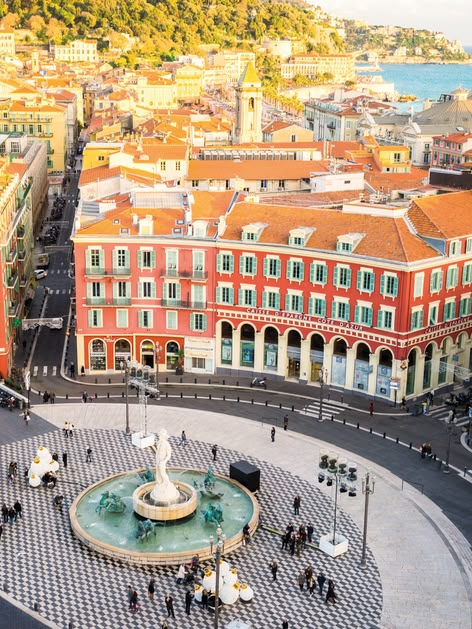
France is the world's most-visited country, with 100 million international visitors in 2024 (UN Tourism), making it both the cultural heart of the Francophone world and the most accessible destination for serious French learners. SPRACHCAFFE operates French schools in France - currently in Nice, on the Côte d'Azur, with year-round adult courses and summer junior camps.
Other European French-speaking destinations include Belgium (Brussels, Liège, Charleroi), Switzerland (Geneva, Lausanne), Luxembourg, and Monaco - all with native French speakers and cultural depth. For non-European learners, Quebec, Canada (Montreal, Quebec City) offers a different Francophone immersion experience with its own dialect and cultural heritage.
The best app to learn French depends on your personal goals and learning style. Some apps focus on vocabulary building and grammar drills, while others concentrate on speaking and listening practice. Many learners use apps for short daily sessions to reinforce what they study in French courses. Apps are practical and flexible, especially if you want to learn French online while travelling or working. For long-term progress, it is helpful to combine digital tools with interactive lessons where you actively communicate.