
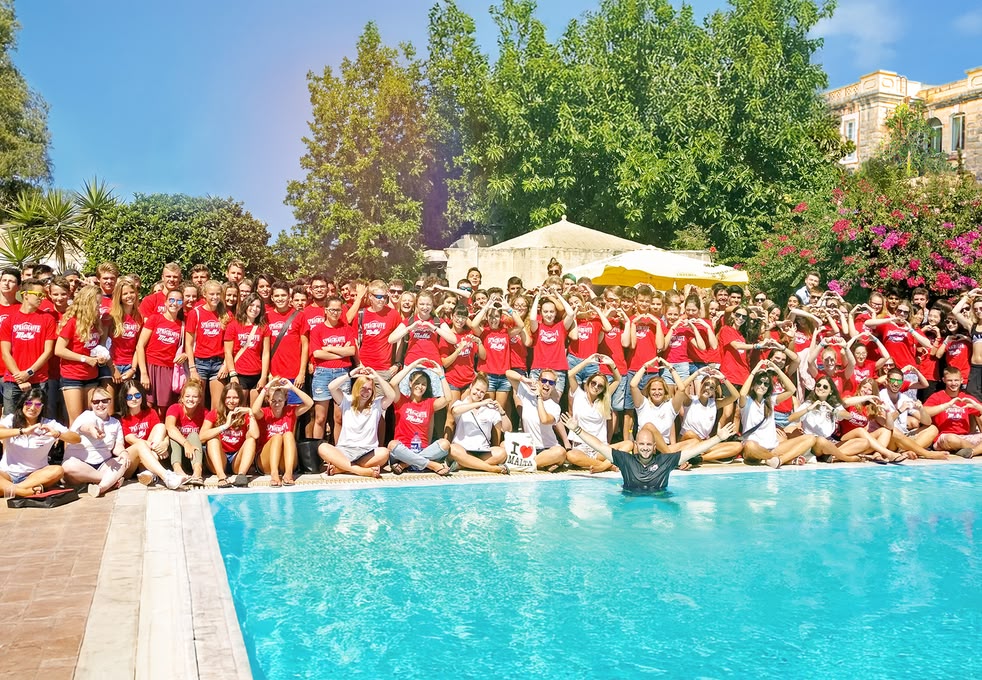
An English summer camp in Malta is a supervised summer course where teenagers learn English in class and then keep using it in everyday island life, from the beach to the bus to the dinner table. It works because Malta is one of the few places in Europe where English is an official language, so the learning does not stop when the lesson ends. At SPRACHCAFFE Languages Plus we have run supervised summer courses for young people for over 40 years, and our two Malta campuses welcome students aged 12 to 21 from across the world.
Real English Progress
Small groups, expert teachers, every level from A1 to C1
One Campus, All Included
Classes, pool, restaurant, bar, beach volleyball - 5 min. from the Maltese coast.
Your Crew, Your Adventure
Meet teens from across Europe. Build friendships that cross borders
Safe. Supervised. Supported.
Our trained Teamers are with your teen every step of the way.
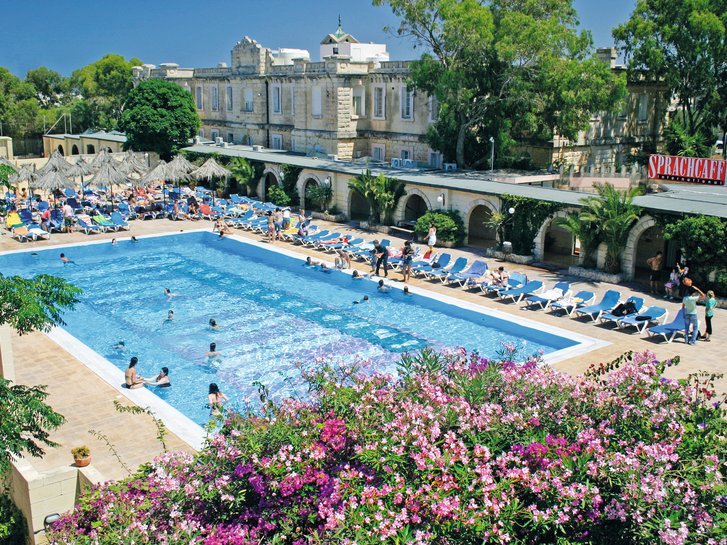

Staff is nice. I'm satisfied with rooms, services include a pool, billiard, food and drinks. This hotel has also a beautiful view and in my opinion, it's suitable for travel groups at affordable prices (like family, students,…etc). A small suggestion from me is that you should spray insecticide to avoid insect bites to tourists. Maybe, one day i will return to this place with my family 🇲🇹😚💯
Quan Le [St. Julian's, Malta]
Why Malta works for learning English
Malta is the only EU member state where English is an official language. The Maltese constitution recognises both Maltese and English as official languages, and English is the everyday language of education, government, business, and tourism. According to the European Commission's Eurobarometer survey, around 90% of Maltese residents speak English fluently, one of the highest rates in the EU.
For a teenager, that changes everything about the trip. The language is not confined to the classroom, because shops, cafés, public transport, and local people all operate in English. Malta also sits inside the EU and the Schengen Area, so travel and entry are straightforward for many students, and the island combines a Mediterranean climate with short distances between the campus, the coast, and the capital.
The English-teaching sector in Malta
Malta has a large and well-established English-teaching sector held to national quality standards, which is part of why so many teenagers come to study English in Malta each summer. In 2024, 80,946 foreign students attended English courses at Malta's 33 licensed English Language Teaching (ELT) schools, according to the National Statistics Office (NSO Malta). Almost half were under 18: 28.1% were aged 15 and under, and a further 22.0% were 16 or 17. The largest groups came from Italy (24.9%), France (10.3%), and Germany (10.1%). For a young learner, that means joining a setting built around their own age group and meeting peers from right across Europe, rather than sitting in an adult programme.
Schools in Malta accredited by FELTOM, the Federation of English Language Teaching Organisations Malta, are inspected against shared standards for teaching, accommodation, and supervision. Both SPRACHCAFFE campuses in Malta hold FELTOM accreditation.
Cambridge Assessment English estimates that learners typically need around 200 hours of guided learning to move from one CEFR level to the next. A focused two to four weeks of summer immersion, where intensive lessons are combined with constant English use outside class, can produce noticeable progress within a CEFR level, especially for beginners and early-intermediate learners.
How an English summer camp in Malta works
On arrival, every student takes a short placement test, online beforehand or on the first Monday, so they join the right group from the start. Classes are small, with a maximum of 15 students per group, and learners are grouped by CEFR level and by similar age. Teachers are qualified and experienced with young learners, and lessons cover the four core skills of speaking, listening, reading, and writing. Course materials are provided on loan, and each student receives a SPRACHCAFFE certificate at the end confirming the course completed and the level studied.
| Course | Lessons per week | Hours per week |
|---|---|---|
| Standard | 20 lessons of 45 minutes | 15 hours |
| Intensive | 30 lessons of 45 minutes | 22.5 hours |
Two campuses: St. Julian's and St. Paul's Bay
We run two campuses in Malta, and they suit different kinds of teenager. Both share the same SPRACHCAFFE standards, with trained Teamers, full supervision, full-board accommodation, and FELTOM-accredited teaching, but they differ in atmosphere, age range, and accommodation.
St. Julian's is the liveliest part of Malta, with restaurants, shops, and entertainment on every street, and the SPRACHCAFFE Club Village sits right in the middle of it. The campus brings classrooms, accommodation, a pool, a beach volleyball court, a restaurant, a bar, a games room, a library, and shaded gardens together on one site, so there is no daily travel between school and lodging. The Mediterranean coast is a five-minute walk away, St. Julian's beach ten minutes, Sliema and St. Paul's Bay fifteen minutes, and Valletta, Malta's UNESCO World Heritage capital, thirty minutes by bus. A reception desk is open around the clock, and trained Teamers live on campus alongside the students they supervise. St. Paul's Bay, on the northern coast in Bugibba, is the quieter, more scenic counterpart, close to the sea and well suited to younger or first-time travellers.
| St. Julian's | St. Paul's Bay | |
|---|---|---|
| Atmosphere | Lively, central, very social | Quieter, scenic, seaside |
| Ages | 12 to 21 | 12 to 17 |
| CEFR levels | A1 to C1 | A1 to B2 |
| Accommodation | Club Village apartments or studios on campus, residence (from age 16), or a local homestay | Residence in Bugibba, three-bed rooms with private bathroom and internet |
| Best for | Confident, outgoing teenagers | Younger or less experienced travellers |
We traveled as a group of students with teachers for 1 week. We were extremely satisfied with the quality of lessons, the equipment of the school and the furnishings of the rooms. The campus is large, with nice gardens and a large swimming pool, which students have always enjoyed using. The food was in the form of buffet and there was always a good selection of food. During our stay, we had activities that were always excellently organized and the school staff was always available and willing to help with everything. Overall, we rate the stay in Malta and the Sprachcaffe school as excellent, and we are definitely going to come back. Thank you for your great service and we wish you many happy students.
Lenka Ležanská [St. Julian's, Malta]
Living English outside the classroom
The day stays full after lessons end. The leisure programme can include beach volleyball, football, kayaking, and aqua-aerobics, with welcome parties, beach barbecues, karaoke, treasure hunts, and photo contests in the evenings. Excursions take students to Valletta, Mdina, Sliema, and Golden Bay, and an optional Intensive Leisure Programme adds even more. Because English is an official language alongside Maltese, students use it to order food, explore, and make friends, which is where a summer course turns into a circle of friends from across Europe. Full board is included, and vegetarian, vegan, halal, gluten-free, and lactose-free meals can be arranged on request.
Safety and supervision for teenagers
Supervision is built into the whole stay. Trained Teamers, usually aged 21 to 30 and drawn from several European countries, accompany the group through lessons, excursions, meals, and evenings, with roughly one Teamer for every 15 students and a round-the-clock emergency contact for parents and students. A Teamer meets each student at the airport, and for younger travellers SPRACHCAFFE offers accompanied flights and an Unaccompanied Minor service where the airline requires it. Free Wi-Fi runs throughout the school and the residence, and we share regular updates with parents during the stay.
Malta isn't just a great choice on paper - the numbers show that families across Europe agree. In 2024, 80,946 foreign students attended English courses at Malta's 33 licensed ELT schools (NSO Malta). Nearly half of them were under 18: 28.1% were aged 15 and under, and a further 22.0% were 16 or 17. So when your teen joins a SPRACHCAFFE camp, they step into a setting built around their age group - not tagging along in an adult programme.
And they won't be the only one far from home. Most students came from Italy (24.9%), France (10.3%) and Germany (10.1%) - exactly the mix of nationalities that turns a summer course into a circle of friends from right across Europe.
Source: nso.gov.mt
Find out more
English is an official language in Malta alongside Maltese, and according to the European Commission's Eurobarometer survey around 90% of Maltese residents speak it fluently. It is the everyday language of school, business, government, and tourism, so visitors can use English throughout daily life.
Malta was a British colony, and English remained an official language after independence. The Maltese constitution today recognises both Maltese and English as the country's official languages, and English is a main language of education and administration.
Malta is well suited to teenage learners. It is an English-speaking EU country with a regulated teaching sector, and in 2024 just over half of the foreign students at its licensed ELT schools were under 18 (NSO Malta). Young learners are placed in classes by age and level, so they study with peers rather than in adult groups.
Cambridge Assessment English estimates around 200 hours of guided learning per CEFR level. A summer course of two to four weeks combines intensive lessons with constant English use outside class, which can produce clear progress within a level, particularly for beginners and early-intermediate students.
SPRACHCAFFE runs its Malta summer courses for young people aged 12 to 21. The St Julian's campus takes ages 12 to 21, while St Paul's Bay runs exclusively for ages 12 to 17. Students are placed in classes with peers of a similar age and English level.
Trained Teamers supervise the group throughout the day and live on campus, with roughly one Teamer for every 15 students and a 24-hour emergency contact. A Teamer meets each student at the airport, accompanied flights are available, and an Unaccompanied Minor service is offered where the airline requires it.
It depends on nationality. EU, EEA, and Swiss citizens enter Malta with a valid identity card or passport and need no visa. Many non-EU nationals can enter visa-free under Schengen rules for up to 90 days within any 180-day period, which covers a summer course, while others may need a Schengen short-stay visa. We can provide enrolment confirmation to support a visa application.