French, often called the language of romance, is one of the most widely learned languages in the world, and you can make real progress on your own with the right mix of resources. Whether you learn best by reading, watching, listening or doing, this step-by-step guide sets out the best way to learn French, from books and films to travel and apps, with practical tips to keep you going.
The Best Way to Learn French: A Step-by-Step Guide
Why learn French French rewards the effort
It is an official language in more than thirty countries, including France, Canada, Belgium, Luxembourg, Senegal, Morocco and Ivory Coast, so it travels well. It opens career doors, particularly in fashion, gastronomy, diplomacy, international organisations and tourism, and many respected universities teach in French. Learning it on your own also means exploring French culture along the way, at your own pace and around the topics that interest you.
1. Books and the basics Traditional study still works,
Regular repetition moves material from short-term to long term memory, and spaced repetition (revisiting words just before you forget them) is built into good course French books. Writing by hand and using audio engage several senses at once, which strengthens recall, and a structured textbook introduces grammar in a logical order so each lesson builds on the last.
For gentle reading practice, graded readers such as the "Lire en français facile" series (published by Hachette) adapt well-known stories to each level, from beginner upwards, so you read real French without being overwhelmed. Pair one course book with one graded reader and you have a solid backbone for self-study.
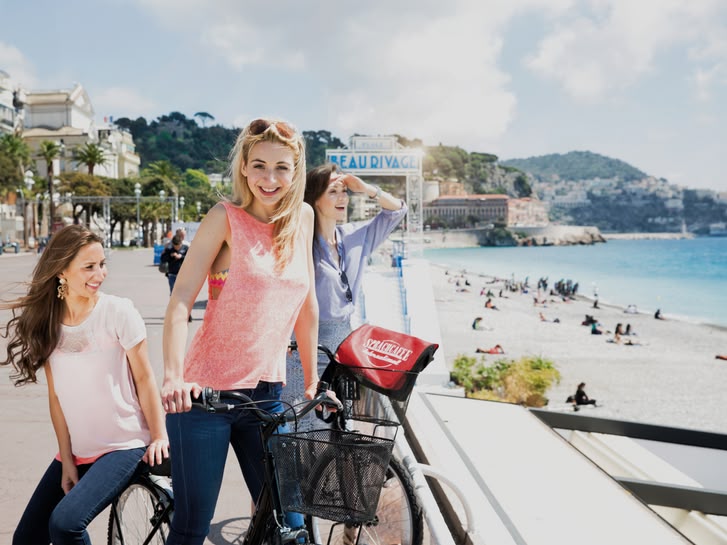
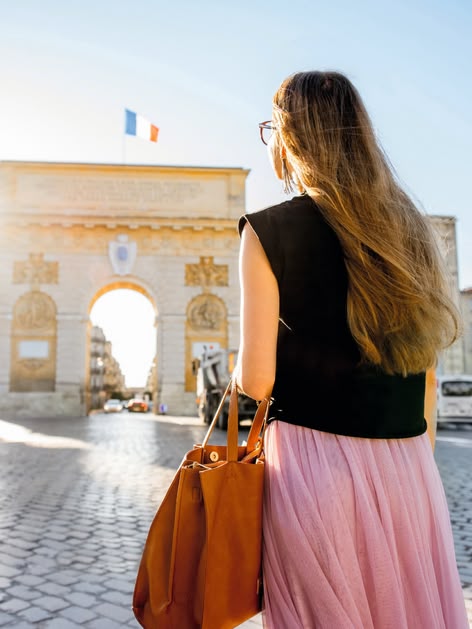
Visit France and learn French

2. Films and TV series by level
Watching French films and series trains your ear and teaches vocabulary in context. Choose by level. For beginners, films with clear, simple dialogue work best: "Le Petit Nicolas", a gently funny story of a schoolboy's adventures, and the animation "Le Grand Méchant Renard et autres contes" (The Big Bad Fox and Other Tales).
Re watching films you already know in French, with French audio or subtitles, also lets you focus on the language rather than the plot. For intermediate learners,
"Intouchables" mixes formal and colloquial French in an engaging story, and the series
"Dix pour cent" (Call My Agent!) is full of practical, everyday Parisian dialogue.
For advanced learners, the classic "La Haine" is rich in slang and idiom, and recent Netflix series such as "Les 7 vies de Léa" (The 7 Lives of Lea) and "Family Business" deliver fast, contemporary speech.
To get the most from them, note down new expressions, watch each film more than once (first for the story, then for the language), and use the subtitle and audio options on streaming platforms.
3. Travel and immersion
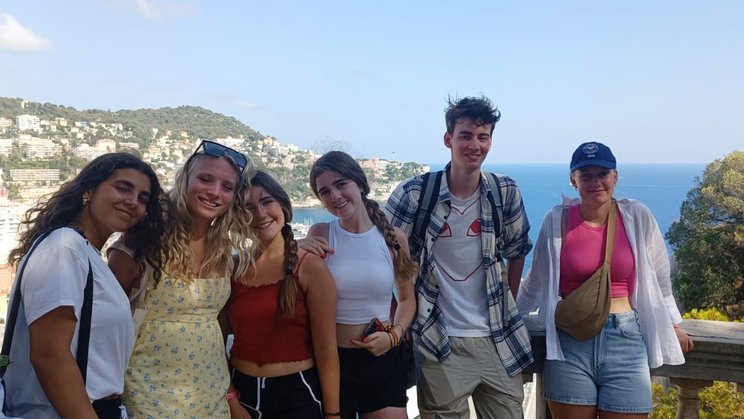
Nothing accelerates French like using it where it is spoken.
On a trip to France, or a French-speaking country such as Morocco or Canada, try to speak to people even when your French is imperfect: in shops, markets and restaurants, locals appreciate the effort and are usually happy to help.
Go to workshops, concerts and festivals to hear authentic French and meet people, and treat everyday tasks (buying a ticket, asking directions, ordering a meal) as free lessons. The more you interact, the faster your confidence grows.
This is exactly the idea behind a language course abroad with SPRACHCAFFE in Nice or Morocco: lessons in the morning, real life in French for the rest of the day.
4. Apps and online tools
Apps make daily practice easy and fit around your life.
- Duolingo turns short, daily lessons into a game, with points and streaks that keep beginners coming back, and it is strong for building a habit and the basics.
- Babbel focuses more on grammar and realistic dialogues, so it helps you start holding conversations.
- Anki is a flashcard app built on spaced repetition, ideal for learning and keeping vocabulary; you can make your own decks or use ready-made ones and add images, audio and example sentences.
App features change over time, so check the current version, and treat these as well-chosen examples rather than the only options.
Tips to learn French effectively
| Tip | Why it works | How to do it |
| Fifteen minutes a day beats three hours on Sunday | Language learning rewards frequency over intensity - daily repetition builds recall | Pick a fixed slot: commute, coffee, before bed |
| Learn phrases, not words | Whole chunks come out ready-made; isolated vocabulary is hard to retrieve | Save "ça me dit", not "dire" |
| Pronounce it aloud from day one | French spelling hides a lot - "ils parlent" sounds exactly like "il parle" | Read your material out loud, even alone |
| Master the sounds your language doesn't have | These are what make you hard to understand, not your grammar | Ten minutes on the "u" in "tu", the "r", and nasal vowels |
| Learn nouns with their article | Gender is nearly impossible to backfill later, and easy to absorb now | Always "le fromage", never "fromage" |
| Listen to things slightly beyond you | Input teaches most when you understand ~80% and reach for the rest | If it feels comfortable, level up |
| Accept the plateau | Around B1 progress stops feeling visible - you're consolidating, not stalling | Track weeks, not days; keep going |
| Speak before you're ready | Fluency is built by speaking, not before it | Say something imperfect today rather than something perfect never |
Summary
The best way to learn French is to combine methods: a course book and a graded reader for the basics, French films and series chosen at your level, real immersion through travel and conversation, and an app such as Duolingo, Babbel or Anki for daily practice. Study a little every day, mix your sources, and speak without fear of mistakes. And to turn steady progress into real fluency, learn where the language lives, on a French course in France with SPRACHCAFFE in Nice or Morocco
FAQ
A mix suits most people: structured lessons or an app for grammar, plus films, podcasts and reading for input, and speaking practice to make it active. Match the methods to how you learn best.
For English speakers, French is one of the easier languages, at roughly 600 to 750 class hours to reach professional proficiency by the FSI measure. Steady daily practice shortens the felt distance.
Yes, to a good level, using books, apps, films and podcasts. What self-study cannot fully replace is regular speaking practice, which is where a course or a stay abroad helps most.
French is official in more than thirty countries and a working language of the UN and EU, so it travels well and opens career doors, alongside a rich culture.
Related news


Get the latest on travel, languages and culture