
German Worldwide: A Borderless Language
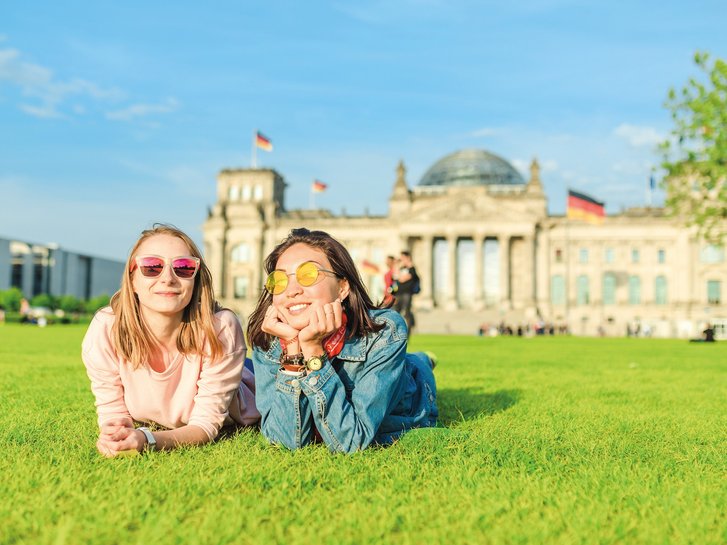
You're sitting in a small café in Windhoek. The sun is fierce, the air smells of coffee and red dust. At the next table, someone calmly orders a slice of apple strudel. In perfect German. You blink.
That's the moment it hits you. German is far more than a European language. It's a cultural network, an economic key and, for millions of people worldwide, the start of a whole new life chapter. More than 100 million people speak German as their native language. Millions more learn it every year as a foreign language.
But how far does the German language really reach? And why has it become so globally relevant?
The German speaking countries at a glance
When you think of the German speaking world, Germany, Austria and Switzerland probably come to mind first. These three are the heart of the German speaking region. But they're far from alone.
German is the official language in six countries:
Germany
The home of standard German, with countless dialects from Bavaria to the North Sea coast.
Liechtenstein
Tiny but thoroughly German speaking. Administration, schools, daily life, all in German.
Austria
Its own words, its own rhythm, its own identity. If you understand Bavarian, you'll find your way in Vienna too.
Luxembourg
German shares official status with French and Luxembourgish. You'll hear it most in administration and the media.
Switzerland
German is one of four national languages here. Swiss German can sound almost like a separate language to German ears.
Belgium
In East Belgium, German is officially recognised, with its own schools and local government.
That makes German firmly anchored in the European linguistic landscape. And remarkably diverse.
More than just one country: The diversity of the German language
What makes German especially fascinating isn't just its geographical spread. It's the variety inside the language itself.
In Germany, you'll meet a wide range of dialects. From the rolling sound of Bavarian to the flat tones of Northern Plattdeutsch. In Switzerland, Swiss German feels like a language of its own. Austrian German has its own melody and a vocabulary all its own. Even between Hamburg and Munich, you'll hear words that no textbook prepared you for.
This diversity tells you something important. German isn't a rigid system. It's a living, breathing organism.
German beyond Europe: A global trail
But the story of the German language doesn't end in Europe. Through migration, trade and historical events, German has spread far beyond the continent.
Today, you'll find German speaking communities in surprising places:
| Brazil: Especially in the south, in Santa Catarina and Rio Grande do Sul. Over a million people still speak German varieties here. In nine municipalities, German has even been given official status alongside Portuguese. |
| Namibia: German is one of eleven recognised national languages, with around 20,000 native speakers. |
| USA: In states like North Dakota and Texas, German speaking communities have survived for generations. |
| Canada: Ontario and Manitoba are home to vibrant German speaking communities with their own traditions. |
| Argentina and Chile: German emigrants founded entire villages here, and the language lives on through their descendants. |
| Italy: In South Tyrol, German is an official regional language alongside Italian. |
| Kazakhstan: Around 358,000 people still speak German, a legacy of the Russian-Germans. |
| Israel: An estimated 200,000 people speak German, a trace of 20th century Jewish history. |
Every one of these language pockets carries its own story. Of migration. Of homeland. Of identity.
How many people actually speak German?
The numbers are striking. Depending on how you count, the German language reaches:
- around 100 to 130 million native speakers worldwide
- over 15 million people learning German as a foreign language
- presence in more than 40 countries
- the most widely spoken native language in the European Union
That makes German one of the most important languages in Europe. Globally, it ranks among the most studied foreign languages, just behind English and Spanish.
Why German is called the "small but mighty world language"
German isn't the most spoken language on the planet. But it's one of the most influential. And there are solid reasons for that.
Economic power
Germany is one of the world's largest exporting nations. If you speak German, you open doors to international companies, especially in Europe. Global names like BMW, Bosch and SAP have offices everywhere, but their corporate language often remains German.
Education and study
Germany is one of the most popular destinations for international students. Many universities offer top-tier education. Often free or very low cost. Studying in German gives you a real advantage.
Science and innovation
In research, engineering and medicine, German has played a central role for centuries. Goethe, Einstein, Kant, Hannah Arendt, Max Planck. To read their original works, you need German.
Culture and history
Goethe, Beethoven, Bach, the Brothers Grimm. German culture has shaped the world in lasting ways. You understand these works best in the language they were thought in.
International organisations
The EU and the United Nations both recognise German as a working language. If you want a seat at that table, German gives you a real edge.
Learning German: A real career booster
More and more people are deliberately choosing to learn German. Why? The reasons are varied:
- better job opportunities across Europe
- access to German companies worldwide
- studying in Germany or Austria
- international career paths
- cultural and personal growth
Here's the surprising part. In countries like Egypt, South Africa and the Dominican Republic, interest in the German language has grown sharply over the last few years. A language once seen as clunky is suddenly cool.
German is challenging. But that's exactly what makes it valuable.

Conclusion: A language with global power
German is everywhere. Sometimes visible, sometimes hidden, but always at work. From European capitals to small communities in South America or Africa, the language carries stories, identity and opportunity within it.
When you learn German, you don't just learn a language. You unlock a worldwide network of possibilities. You connect with 130 million people. You step into a world far bigger than the map suggests.
So, what are you waiting for? Language travel with SPRACHCAFFE in Frankfurt or Munich lets you experience German exactly where it lives - and turns learning into real life.