You can learn Arabic in Morocco in a way that few classrooms at home can match, with the language around you from the moment you step outside. Morocco is a country where two everyday languages meet: Darija, the spoken Moroccan Arabic, and French, which is widely used alongside it. Behind both sits Modern Standard Arabic, the written form shared across the Arab world. At SPRACHCAFFE we run our own language school in Rabat, as part of a company that has taught languages since 1983. This guide explains what you actually learn when you study Arabic in Morocco, why immersion suits adult learners, and how to choose a course that fits your goals.
Arabic in its Natural Setting
Practise with locals in one of North Africa's most vibrant capitals.
Courses for Every Level
From complete beginners to advanced speakers - all are welcome.
Flexible Course Formats
Standard, Intensive, Mini Group or One to One - you choose the pace.
Educational Leave Eligible
Many of our adult courses qualify for recognised educational leave.
What language you actually learn in Morocco
In Morocco, the Arabic you hear in the street is Darija, while the Arabic you read in newspapers and official documents is Modern Standard Arabic. Understanding the difference helps you decide what to study before you go.
Moroccan Arabic (Darija)
Darija is the everyday spoken Arabic of Morocco. It grew from classical Arabic and carries clear influences from Amazigh, also known as Berber, as well as from French and Spanish. You hear it in conversation, at home, in the markets and among friends, from a simple greeting such as salam to fast everyday exchanges, and it is understood across Morocco and, broadly, across North Africa and the wider Maghreb. If your aim is to talk with people during a stay in the country, this is the variety you will use most.
Modern Standard Arabic and how it differs
Modern Standard Arabic, also known as Fusha, is the standardised form of Arabic used in writing, media, education and formal settings across more than twenty countries. It is spoken by hundreds of millions of people as a shared written and formal language, even though everyday speech varies from region to region. Modern Standard Arabic is the better starting point if you want to read, study formally or communicate across different Arab countries. For a broader introduction to the language itself, see our guide on how to learn Arabic. How to learn Arabic
Where French fits in
French is part of daily life in Morocco and appears in business, administration and education alongside Arabic. At our school in Rabat you can choose between Arabic and French, or combine the two, which makes Morocco a practical destination for learners who value both. French courses in Rabat
| Feature | Moroccan Arabic (Darija) | Modern Standard Arabic (Fusha) |
|---|---|---|
| Mainly used for | Everyday speech in Morocco | Writing, media, education, formal settings |
| Where it is understood | Morocco and, broadly, the Maghreb | Across the Arab world |
| Best for | Talking with people in daily life | Reading and formal communication across countries |
| How you pick it up | Conversation and immersion | Structured study of grammar and script |
Why learn Arabic in Morocco
Learning a language in the country where it is spoken turns study into daily practice. Adults tend to make the fastest progress when structured practice is combined with real communication from the first day, a point stressed by Prof. Dr. Jürgen Beneke, who researches applied linguistics and language teaching at the University of Hildesheim. Immersion gives you that combination without effort, because the practice continues after the lesson ends.

Rabat as a place to study Arabic
Rabat is the capital of Morocco and offers a calmer setting than the busiest tourist cities, while still surrounding you with everyday Arabic and French. When you learn Arabic in Rabat, the city itself becomes part of the lesson. Our SPRACHCAFFE Arabic language school sits in the heart of the city, with the main avenue, Avenue Mohamed V, about five minutes away and the historic Medina roughly ten minutes on foot. Between lessons you can practise what you have learned over a glass of mint tea in the Kasbah of the Oudayas, with a view of the Bou Regreg river, or explore the markets and the Mausoleum of Mohammed V.
Learning through immersion
Immersion works because it removes the gap between the classroom and real life. You learn a phrase in the morning and use it the same afternoon, with shopkeepers, classmates and hosts. This is why many adults choose to learn Arabic abroad rather than at home, because the practice continues long after the lesson ends. For adult learners in particular, this steady, low-pressure repetition builds confidence faster than study alone.
How to choose an Arabic course in Morocco
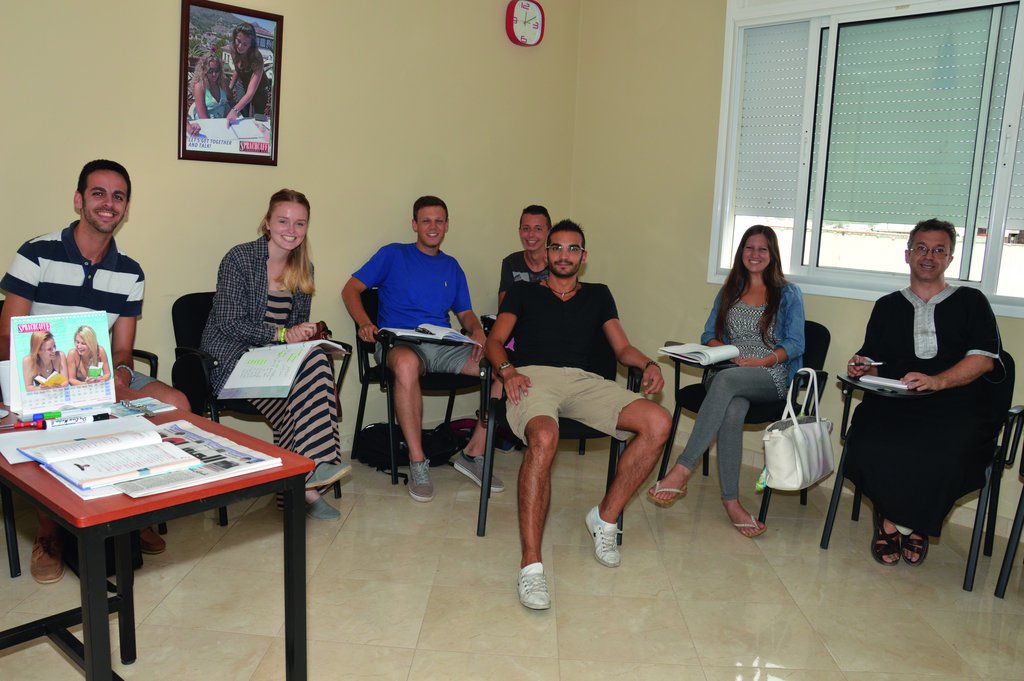
Your choice depends on how intensively you want to study and how much time you have. At our SPRACHCAFFE school in Rabat, one lesson lasts 45 minutes, and you can select from several course formats:
- Standard course: 20 lessons per week, with a maximum of 12 learners per class.
- Mini standard course: 20 lessons per week, with a maximum of 4 learners for a more personal setting.
- Intensive course: 30 lessons per week for faster progress.
- Combined Arabic and French: 20 lessons in one language plus 10 in the other each week, with a maximum of 10 learners.
- One-to-one tuition: 10 lessons per week, fully tailored to your needs.
- Study Club: 4 lessons per week, included at no extra cost, to review and practise together.
A placement test on the first day matches you to a class at your level. If too few learners share a level for a group, we run the course as semi-private or private tuition for at least 60 percent of the booked time, at no additional cost, so your learning never stops.
| CEFR level | What it means |
|---|---|
| A1 Beginner | You understand and use basic everyday phrases. |
| A2 Elementary | You handle simple, routine exchanges on familiar topics. |
| B1 Intermediate | You cope with most situations while travelling and describe experiences. |
| B2 Upper intermediate | You interact with some fluency and discuss a wide range of topics. |
| C1 Advanced | You use the language flexibly for social, academic and professional purposes. |
| C2 Proficient | You understand almost everything and express yourself precisely. |
Learn more about Adult Language Courses
What an Arabic immersion stay looks like
Your days combine focused lessons with the life of the city, and where you stay shapes how much you practise. In Rabat we offer a homestay with half board, which places you in a Moroccan household and gives you conversation every evening. You can also choose a riad guesthouse with an en-suite room, or a hotel, depending on how much privacy you prefer. Beyond the classroom, an optional excursion to Oulja includes a pottery workshop with a local guide, so the language comes with the culture, the food and the people you meet along the way.
Practical basics for studying Arabic in Morocco
A few practical points make planning easier. Our school in Rabat is accredited by the OFPPT under the Contrats Spéciaux de Formation. Every course begins with a placement test, and every participant receives a SPRACHCAFFE certificate of attendance on request. Courses for most levels start every Monday through the year, while complete beginners start on set dates. If you would like a transfer, we can arrange one from Rabat airport or from Casablanca airport.
Find out more
Darija is the spoken Moroccan variety of Arabic. It shares its roots with Arabic but includes influences from Amazigh, French and Spanish, so it differs from the Modern Standard Arabic used in writing and formal settings.
The best variety depends on your goal. Learners who want to live, travel or work in Morocco benefit most from Darija, while those who want to read, study formally or communicate across the Arab world usually start with Modern Standard Arabic.
Both are part of language study in Morocco. Our SPRACHCAFFE school in Rabat teaches Arabic and also lets you combine Arabic with French, and a placement test on the first day matches you to a class at the right level.
Yes. Complete beginners are welcome. At our school in Rabat, beginner courses start on set dates through the year, while other levels can begin every Monday.
French is widely used in Morocco alongside Arabic, in business, education and daily life. At our school in Rabat you can choose between Arabic and French, or study both.
Rabat is the capital of Morocco and offers a calmer setting than the largest tourist cities, with everyday Arabic and French around you. Our school sits in the heart of the city, about ten minutes on foot from the historic Medina.