
In this guide, we explore everything you need to know about these important grammar elements — from definitions to usage, examples, translations, and differences between simple and complex prepositions in French. By the end, you’ll understand how these small but powerful words function and how to use them confidently in your everyday French.
French Prepositions: Simple and Complex Form
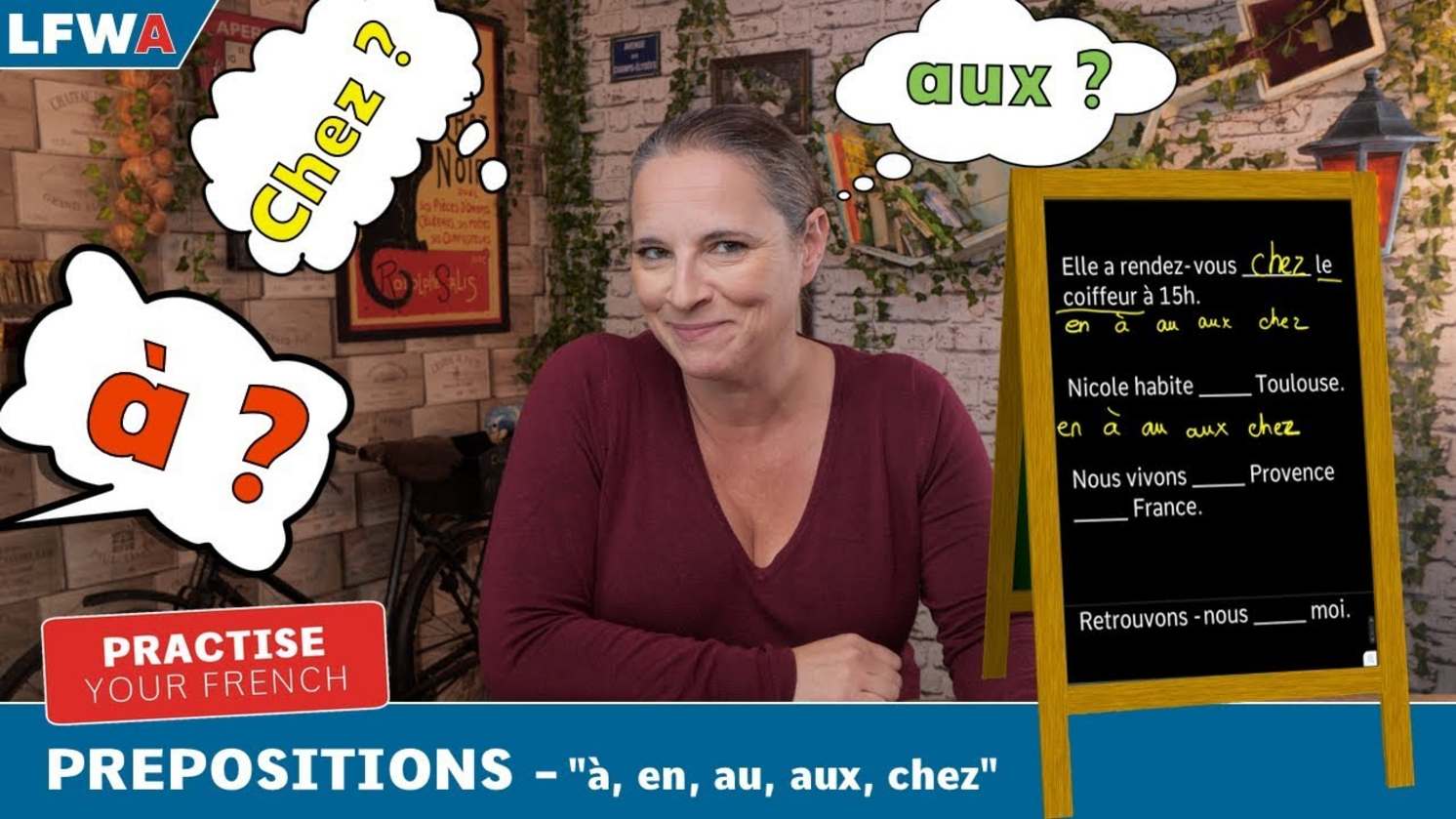
Simple Prepositions in French
Let's start with simple prepositions in French , which naturally also form the basis for complex prepositions. As in Italian, French prepositions are very short words that indicate a relationship between words within a sentence.
Ours are " di", "a", "da", "in", "con", "su", "per", "tra", "fra "; the French ones are quite similar, although they have some peculiarities in usage, which we'll see in this article.
Here is a table of simple prepositions in French with their translation and a small example:
| French Preposition | Translation | Example |
| à | a | *à* 7 heures |
| avec | con | *avec* ma mère |
| de | da, di | Je parte *de* Rome Il vient *de* Rome |
| en | in | une chemise *en* coton |
| pour | per | je le fais pour toi |
| par | par | je passe par le parc |
There are also other prepositions with similar meanings, such as depuis and dans : they translate respectively as "from" and "between", but they can be used provided that the sentence specifies the exact moment in which the action indicated by the verb begins.
Example:
- J'attends depuis trois heures. = I've been waiting three hours.
- Je devrais être à la maison dans trois heures. = I should have arrived home in three hours . / I should be home in three hours.
Another important preposition to know is sur - with its opposite sous -: they are used to very simply mean "up, above" and "under".
Example:
- Il faut toujours dire sur tout. = You always have to say something about everything.
- J'ai vu ton cahier sous la table. = I saw your notebook under the table.
Now, however, let's return to analyzing the main simple prepositions in French: let's look at them one by one and discover how they translate exactly and when they are used, with special cases and translations.
The Preposition à
Perhaps the preposition that most identifies the French language, the preposition à, as we have said, is translated with our " a ", but in reality it can be applied in slightly different ways than in Italian, and often to translate it into Italian we have to resort to our articulated prepositions.
Mainly, it is used for:
- Give information about the time
à deux heures = at ten o'clock - Introduce a state complement in place
of à la maison = at home - Introduce a complement of motion to place
On va à la montagne! = Let's go to the mountains! - Indicate membership or ownership .
This style belongs to François. = This pen belongs to François. - Indicating the function of an object , often speaking about household appliances.
J'ai acheté une nouvelle machine à laver. = I bought a new washing machine.
As we mentioned, there are many differences in the use of simple prepositions in French compared to Italian. For example, in some cases they are used in place of other prepositions, such as when in Italian we have da + infinitive :
There is nothing to fear = Il n'y a rien à craindre
And also in many cases where we would use the preposition "in":
in time = à temps
on his knees = à genoux
by bicycle = à bicyclette
in the future = à l'avenir
able to = à méme de
In other cases, however, the preposition à is omitted :
- If it follows a verb of movement + infinitive:
I have to go and buy flowers = Je dois aller acheter des fleurs - In some expressions, such as prices "per kilo":
This cheese costs €20 per kilo! = Ce fromage coûte 20€ le kilo!
Also pay attention to the following particular cases, in which we might instinctively use the preposition à but in reality it would be an error:
- By the thousands = par milliers
- A voce = de vive voix
- In color = de colors
- A memoria = par coeur
The Preposition avec
The simple preposition avec translates our " with ," and therefore serves to introduce the same complements it does in Italian: company, means, and manner.
Let's look at some examples of its use:
- Companion of companionship
J'ai vu Marie avec Julie hier soir. = I saw Marie with Julie last night.
Avec toi, tout est plus amusant. = Everything is more fun with you.
Viens avec nous! = Come with us! - Half complement
J'ai cassa la noix de coco avec le marteau. = I broke the coconut with the hammer.
With a little chance, nous le ferons. = With a little luck we'll make it. - Manner complement C'est avec plaisir que je vous rejoins pour un café. =
It is with pleasure that I join you for a coffee.
I repeated it with insistence. = He repeated it insistently.
With perseverance, you can pay attention to that object. = With consistency you can achieve any goal.
Here too, there are some translation differences to note. When we talk about means, meaning means of transportation , where we use "con," other prepositions are used in French:
by plane = by plane
Even when we talk about weather conditions we don't use avec:
in this weather = par ce temps
It will probably sound very strange to you, but when we want to say with + a body part , in French we don't use avec but rather de:
with my eyes = de mes yeux
with my hands = de mes mains
The Preposition de
Now let's talk about the preposition de , one of the most widely used prepositions in the French language. This is because it corresponds to not one, but two of our simple prepositions, and in fact we can translate it either as " di " or " da " depending on the context. In fact, in some cases we can also translate it as "in," and in others even as "con"! In short, learning to use it is essential to gaining confidence when speaking French.
The preposition de is used for:
- Indicate where you come from
Sara vient de Gênes. = Sara comes from Genoa. - Talking about the author of a work
J'ai vu le dernier chef-d'œuvre de Banksy = I saw Banksy's latest masterpiece. - Introduce the specifying complement
C'est le déjeuner de Ben, ne le mange pas. = It's Ben's lunch, don't eat it. - Introduce the manner complement.
Se comporte de manière agressive. = He behaves aggressively .
Quand il vous parle, il le fait d' une voix douce. = When he speaks to you, he does so in a soft voice. (With a word that begins with a vowel, we can eliminate the -ee and replace it with an apostrophe.)
The preposition de is also used after the formula verb etre + adjective + infinitive :
Example :
Il est interdit de marcher sur l'herbe. = It is forbidden to trample on the flowerbeds.
And after some verbs, in sentences where, in Italian, it is usually omitted:
- Il suffit de parler et tout est résolu = Enough talking and everything is solved.
- Un homme s'est approché de ma maison = A man approached my house.
- On ferait mieux de rentrer, il va pleuvoir. = We better go back inside, it's about to rain.
Conversely, we omit the "de" in French after verbs of opinion, whereas in Italian we would use it. Verbs of opinion are those that introduce a thought, such as: croire (to believe), penser (to think), souhaiter (to desire), affirmer (to affirm), dire (to say), espérer (to hope). Let's look at some examples of this case too:
- J'espère pouvoir vous voir dawn morning. = I hope to be able to say hello to you tomorrow morning.
- Je pense avoir gagné le pari. = I think I won the bet.
Here too, we must pay attention to certain common expressions that in Italian are known to start with "di", but which in French are introduced by another preposition:
- in summer = en été
- in winter = en hiver
- di giorno = le jour (here we even replace the preposition with the definite article)
- at night = la nuit
- secretly = en cachette
The Prepositions Pour and Par
Just as in Spanish we find the great problem of " por y para ", also in French grammar presents us with the dilemma of how to translate " per ": in this case, the doubt arises between the simple French prepositions pour and par .
Pour is used for:
- Indicate the destination
Nous partons pour Madrid = We are leaving for Madrid. - Introduce the cause complement
Pour cette raison, je suis allé à l'école en vélo = For this reason I went to school by bike. - Introduce the final complement
Il a écrit une lettre pour se rattraper. = He wrote a letter to ask for forgiveness.
While par is used for:
- Indicate a passage through
On passe par la plage, c'est plus rapide. = Let's go through the beach, it's quicker. - Introduce the agent or efficient cause complement (in Italian, "da" is used).
Cette chanson a été écrite par ma mère. = This song was written by my mother.
J'ai été frappé par une pierre. = I was hit by a stone. - Enter the middle complement:
Je vous envoie tous les documents par email. = I'm sending you all the documents by email .
There are some cases in which in Italian we prefer to use con, while in French it is correct to use the simple preposition par:
- J'ai fini par accepter une offre indécente = I ended up accepting an indecent proposal.
- The book begins in a very long phrase. = The book begins with a very long sentence.
Articulated Prepositions in French
Now that you know everything you need to know about the simple prepositions, let's move on to the French articulated prepositions , called articles contractés. As you might guess, articulated prepositions are formed by combining simple prepositions and definite articles, and are used to be more specific and provide more detailed information about the sentence that follows them.
To form French articulated prepositions, we use the simple prepositions à and de, and the definite articles le , la, and les , which translate our "il," "le," and "gli ."
Unlike Italian, however, the contraction and union between the two particles is not always so intuitive, and the most obvious example is that of the preposition au , which comes from the union of à + le .
We can consider singular prepositions "in pairs", since they translate the same preposition but in different grammatical situations.
Let's start with the singular masculine prepositions , which are:
- au = à + le = al
It is used before words that begin with an aspirated h or a consonant:
Je vais au cinéma avec Luigi. = I'm going to the cinema with Luigi.
Je suis au travail! = I'm at work! - a l' = à + l' = al
Same translation, but we use it before words that begin with a vowel:
Je pars à l' étranger. = I'm going abroad. - du = de + le = del It is used before words that begin with an aspirated h or consonant:
Ce livre est du Luc. = This book is by Luke. - de l' = de + l' = del
Here too, the same thing happens, we use this version for words that begin with a vowel:
Ce livre vient de l' école. = This book comes from school.
Even in the feminine singular we find a similar situation:
- à la = à + la = alla
For nouns with an aspirated oh consonant:
Je suis allé à la Gare = I went to the station - à l' = à + l' = alla
For names with an initial vowel:
Je suis allé à l' école = I went to school - de la = de + la = della
For nouns with an aspirated consonant or vowel:
C'est la veste de la dame au chapeau. = It's the lady 's jacket with the hat. - de l' = de + l' = della
For words that begin with a vowel:
Que retiens-tu de l' autre soir ? = What do you remember from the other night?
Finally, there are the French plural prepositions , which are the same for masculine and feminine and correspond to:
- Aux = à + les = gli, ai, alle
Avez-vous dit aux enfants? = Did you tell the children?
Aux amis, vous pouvez tout dire. = You can tell your friends everything.
Je me suis levé aux premières lueurs = I got up at the crack of dawn. - Des = de + les = degli, dei, delle
Je t'ai acheté des fleurs. = I bought you some flowers.
J'ai des choses à te donner. = I have some things to give you.
It's the fault of the innocent. = It's the fault of the innocent.
To recap, here's a table listing all the French prepositions:
| male | female | plural |
| au = à + le | à la = à + la | aux = à + les |
| a l' = à + l' | à l' = à + l' | |
| du = de + le | of the = of + the | des = de + des |
| de = de + l' | of the = of + the |