10 Spanish Love Phrases You Should Know (With Translations)

Composition and tips for using love phrases in Spanish | Among the languages ​​considered the most passionate and romantic is certainly Spanish: thanks to its sonority and the sweetness of its words, in fact, it is the perfect language through which to express the deepest feelings.
 

Choosing to dedicate love phrases in Spanish to your significant other or to a previously secret love can be the winning card to win their heart: but which ones should you use to avoid coming across as banal?

Here are 10 Spanish love quotes that perfectly express the most important feeling of all. For each, you'll also find the corresponding translation and the appropriate context.

A Romantic Quote by Jorge Luis Borges to Express Love

Let's start with one of the most beautiful phrases the Spanish language can boast, written by Jorge Luis Borges, an Argentine writer and poet who worked primarily in the fantasy genre.

The sentence is as follows: Being contigo or not being contigo is the medicine of my time .

Translation: "To be with you or not to be with you is the measure of my time."

It's part of a poem called El amenazado (The Threatened One), and expresses in a few simple words the importance of time spent with a loved one. When they're there, it's time well spent; when they're gone, their absence is the only thing we can focus on.

There are some loves that seem to end, that make you cry and suffer, but that in reality remain alive and strong like a flame that never wants to go out. There's a quote by Miguel de Cervantes that can help express this feeling:

No love lost among us.

Its translation is: "There is no love wasted between us," and it's very helpful in describing a love that's hard to die. And one that may cause suffering, but it certainly helps us feel alive, to face the world and move forward with hope in our hearts. In short, it's never wasted.

The most beautiful love phrase in Spanish

There's a Spanish love phrase everyone knows, and just saying it makes you feel inexplicable emotions. It goes like this:

I want to do what spring does with the flowers .

The translation is: " I want to do with you what spring does with the cherry trees ," and dedicating it is a demonstration of love far greater than many ostentatious gestures. This is because the spectacle of the cherry trees in bloom in spring is something incredible, and indeed only those who love can truly appreciate it.

We can thank Chilean poet Pablo Neruda for this-and many other-beautiful Spanish love quotes: another memorable one from his pen is "Para mi corazón basta tu pecho, para tu libertad bastan mis alas," which means "your chest is enough for my heart, my wings are enough for your freedom."

A romantic and never banal dedication

We've always instinctively compared our loved ones to the stars: perhaps because they shine, perhaps because the starry sky at night offers such a breathtaking spectacle... So why not do it in Spanish too?

A phrase like: " In the sky there are millions of stars, in my life there is only one, and that is you ," which we translate as "In the sky there are millions of stars, in my life there is only one, and that is you," can make our loved one feel how much we care. It reminds them that there is nothing, in our eyes, more beautiful and more important.

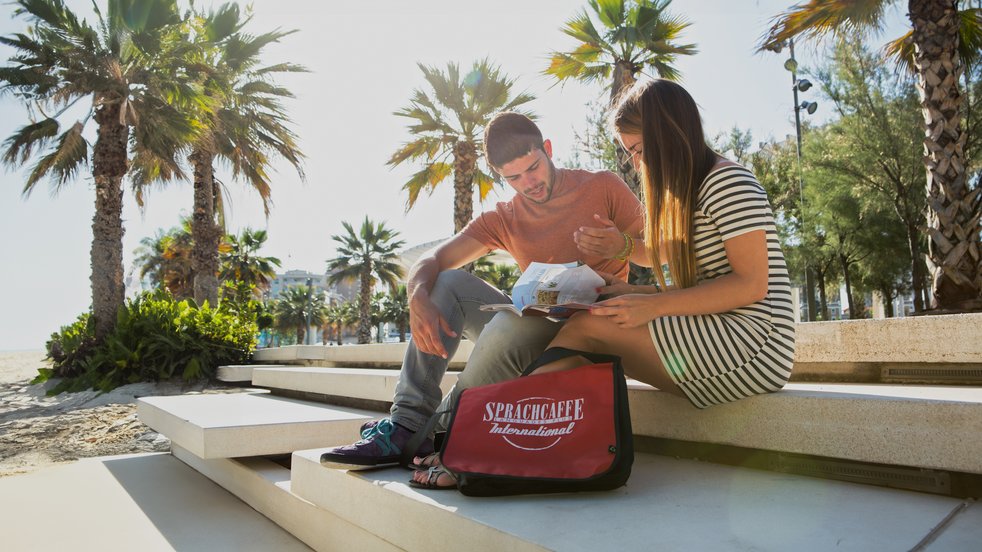
Two Sprachcaffe students sitting by the beach in Spain, reading a map with palm trees in the background.
Spain
Sun, tapas and lust for life

Frida Kahlo Love Quotes in Spanish

Mexican painter Frida Kahlo is a must-see when discussing Spanish love quotes. Beyond painting, Frida left her mark on the world with her passionate and heartbreaking love poems, some of which have gone down in history as truly unforgettable, capable of melting even the hardest of hearts.

The one we are talking about now is the following:

Here you need to give yourself everything that you will never be able to hold, and you will never know the wonder that it is possible to love you .

Translation: I wish I could give you everything you've ever had, and even then you wouldn't know how wonderful it is to be able to love you.

Dedicating this love phrase in Spanish will allow the person you love to feel how strong your feelings are for them, and how grateful you are every day for even the chance to love them, considering this opportunity a privilege.

A short but impactful sentence

Especially if it's a first love, the person you're with is allowing you to explore and fully understand this feeling, which was previously unknown to you. A sentence to express this concept:

If you know what love is, it's thanks to you.

Simply: "If I know what love is, it's thanks to you."

A phrase to talk about a deep love

In love, the kind that's true, deep, and sincere, there's no embarrassment: you can be silent without feeling uncomfortable, and share even-and especially-the saddest and most uncertain moments of your life. It's easy to be there when everything's going well, but only those who truly love stay, even during the storm, right?

Thanks to the Colombian writer Gabriel Garcia Marquez we can express this concept with an extremely evocative phrase:

And if one day we don't have the chance to talk to Nadie, call me… we'll be in silence.

Translated into Italian: "And if one day you don't feel like talking to anyone, call me... We'll be silent."

Spanish Love Phrases to Share With Someone Special

Sometimes you just want to find a way to express how you feel about that person, how good they make you feel, and thank them for the wonderful feelings they make you feel every time you're together.

There is a love phrase in Spanish that fits this situation:

I don't love you because you were, but because of how you made me feel when you are close to me.

Translation: I don't love you for who you are, but for who you make me be when I'm with you .

Some people simply do us good, and it's right to remind them of it from time to time, to give them credit and make them feel special. Because yes, because they are.

Another way to say "you are my happiness"

The phrase "you are my happiness" is very sweet, but to avoid being too banal you can replace it with the following:

I realize that there are those who many call happiness.

Translated into Italian it sounds like this: I feel that you are what many call happiness.

Simple, romantic, and impactful: certainly a phrase that touches the heart. After all, knowing you can make someone happy can only make us happy in return, and feel like we've done something good for someone we love.

A phrase that looks to the future

The next and tenth quote we'll look at isn't originally a Spanish love quote: it's a small "theft" from French literature, and specifically from the writing of Antoine de Saint-Exupéry. One of his most famous love quotes has been translated worldwide, and in Spanish it's the following:

Loving is not looking at one another; It's looking at joints in the same direction.

Translation: To love is not to look at each other; to love is to look together in the same direction.

There's no need for much explanation: focusing on the present moment is typical of those experiencing the first moments of falling in love, but a phrase like this represents a more experienced love, of someone who is capable of looking to the future and always seeing the other person by their side.

How Do You Say “My Love” in Spanish?

Finally, it might be helpful to know how to say "amore mio" in Spanish . It's not complicated; in fact, we say it exactly the same way as in Italian, basically. In fact, "amore mio" in Spanish is " Amor m í o ," with the only difference being the accent on the "i," which must be written in Spanish. An example of how it's used might be the sentence:

Felicidades, amor mío = Best wishes, my love

As you might guess, my love in Spanish is mi amor , and it's often used as a filler and nickname to refer to your partner. Some usage examples:

  • You are my love forever. = You are my love forever.
  • Mi amor , ¿estás bien? = My love, are you okay?
  • Mi gran amor eres tú. = You are my great love.
  • Hasta luego mi amor . = See you later, my love.

In many other cases, it's replaced by other words: Spaniards are known for using countless nicknames to refer to their boyfriend or girlfriend, and they're certainly also a way to express love in Spanish. Let's look at a few:

  • Cariño = dear. In reality, cariño represents a feeling of great affection and sweetness and doesn't have a specific Italian word for it. We can translate it as "dear" but also as "darling" or "sweetheart." Suffice it to say that it's an affectionate nickname and doesn't mean "cute."
  • Nena = darling, little one. This word originally came about as a diminutive for a little girl (or nene , for a little boy). Many people use it as an affectionate nickname for their girlfriend, similar to "baby" in English. And in Spanish, by the way, the nickname " bebe " is often used, or the even more diminutive " bebito/bebita ."
  • Coraz ó n = heart. Who doesn't know this Spanish word? Even in Italian, it's often used as a nickname, and in Spanish it can also become "mi corazón."
  • Dulzura = sweetness, sugary. Considered by many to be extremely-perhaps too much-sappy, it's one of the sweetest nicknames ever to use to express love in Spanish.
  • Querido/a = perhaps the most accurate translation of our dear or dear, since it's also used to begin letters. In everyday life, it's used as a sweet term to refer to one's partner.
Attractive Learning Destinations

Our Spanish schools are located in popular Spanish cities with a high quality of life - from bustling metropolises to sunny coastal areas.

High-Quality Teaching

All of our schools meet high-quality standards and provide professional Spanish lessons at a native-speaker level.

International Community

Learn alongside motivated international students in courses tailored to every level and learning goal.

Activities

Through excursions and leisure activities, you'll actively use your Spanish outside the classroom and experience Spanish culture firsthand.

Why the community loves SPRACHCAFFE

We’re just one message away

Get in touch with us

Meet SPRACHCAFFE face to face

Prices & details in your hands

Explore FAQ from our students and their parents

The Junior (U20) Program is designed for students aged 12-21 who want to improve their language skills while experiencing life abroad.

  • Ages 12-17: Fully supervised language camps with structured lessons, activities, and 24/7 support.
  • Ages 18-21: More independence with flexible support, ideal for young adults who want to combine learning with cultural exploration.

The program is offered as an all-inclusive package that covers everything students need during their stay:

  • Language course with placement test, learning materials, and a certificate of completion
  • Accommodation with full board (dormitory, host family, or campus, depending on the destination)
  • Airport transfer (sometimes for a small additional fee)
  • 24/7 supervision by trained team members (for ages 12-17)
  • Weekly leisure and excursion program

The costs vary depending on the destination, length of stay, and course intensity, but the package ensures that parents don't have to worry about hidden fees. Optional extras, such as extended activity packages or elective workshops, can be added for an additional charge.

The cost of a language camp depends on the location, duration, and type of program.

Example: 2 weeks from approximately €1,500.

Additional costs may include travel insurance, flights or transport to and from the camp, and extra activities or excursions outside the standard program.

Student safety is the top priority at SPRACHCAFFE.

  • Supervised programs with dedicated local contacts
  • Age-appropriate accommodation (host family or residence)
  • Supervised leisure activities and excursions
  • Emergency numbers and 24/7 availability

Depending on the destination and program, students stay:

  • With carefully selected host families
  • Or in supervised student residences

All accommodations are regularly inspected and provide a safe, age-appropriate environment. Staying with a host family also allows students to practice Spanish in everyday life.

The lessons are specially designed for students:

  • Small classes
  • Age-appropriate teaching methods
  • Communicative lessons with a focus on speaking
  • International learning groups

Lessons usually take place in the morning and are complemented by a supervised leisure program.

For Spain:

  • Spain is part of the Schengen Area
  • EU citizens do not need a visa
  • Non-EU citizens may require a Schengen visa

SPRACHCAFFE assists parents with visa checks and all necessary documents.

Yes. On many travel dates, you can choose an escorted flight. From the very start, you won't be alone: the team members help you with check-in, show you the way through the airport, and accompany you throughout the entire flight.

This way, you start your trip relaxed, feel safe, and have a familiar contact person by your side from the very first moment - ideal if it's your first time traveling alone or if you simply want a stress-free start to your student language trip. After landing, the support continues seamlessly: you will be greeted directly at the destination airport and safely accompanied to your transfer.

All available dates for escorted flights can be found in the catalog, or you can request them as part of your personal offer.

Spanish Language Trips During the Easter Holidays

The Easter holidays are the perfect time for a SPRACHCAFFE Spanish language trip for students. Instead of learning in a classroom, you’ll experience Spanish where it’s actually spoken – in Spain, for example in Barcelona or Málaga. This way, you spend your holidays meaningfully, improve your language skills, and gain unforgettable international experiences.

Our SPRACHCAFFE student language trips combine high-quality lessons with a variety of activities. You’ll use Spanish in real-life situations, explore new cultures, make new friends, and return home confident and motivated.

Saying I Love You in Spanish

Maybe these Spanish love phrases seem a bit overwhelming, and you're looking for something simpler to whisper to your significant other to surprise them in the middle of the day. What's better, then, than a simple " I love you" in Spanish ?

The main translation of "I love you" in Spanish is " te quiero ." It's used for love between couples, for children, or for parents, but also to express affection towards friends. In short, it can also be translated as "I love you," but it's not unusual to use it as "I love you" towards your significant other.

Often, to express the depth of the feeling, it's accompanied by the adverb " mucho ," meaning "very much": " te quiero mucho " is one of the most famous Spanish love phrases around the world! And in reality, " mucho " is often added to take some of the heaviness out of "I love you," paradoxically, to lighten it a bit: in any case, it depends on the context in which it's said.

Alternatively, you can also add the word " demasiado ", which translates as "too much," to quantify a love so great that it is even excessive.

Examples:

  • I can't unsubscribe, I want you sent ! = I can't go, I love you too much!
  • I want you a lot and let me show it to you. = I love you so much and I wish I could prove it.

To be precise, in Spanish there's also te amo , a much more serious and heartfelt way to express the concept of love. It's never used inappropriately: a Spaniard doesn't say "te amo" lightly , but only when he truly feels it from the bottom of his heart. Between engaged couples, it's usually used on special occasions or in moments of particular emotion, rarely in everyday life when the expression "te quiero" is preferred.

  • Te doy este anillo porque te amo , hoy y siempre. = I give you this ring because I love you, today and forever.

There's also a much lighter version of expressing appreciation, usually limited to physical appearance or just an initial interest, when you're not ready to go too far. We're talking about " me gustas ," which simply means "I like you."

How Do You Say “My Love” in Spanish?

Finally, it might be helpful to know how to say "amore mio" in Spanish . It's not complicated; in fact, we say it exactly the same way as in Italian, basically. In fact, "amore mio" in Spanish is " Amor m í o ," with the only difference being the accent on the "i," which must be written in Spanish. An example of how it's used might be the sentence:

Felicidades, amor mío = Best wishes, my love

As you might guess, my love in Spanish is mi amor , and it's often used as a filler and nickname to refer to your partner. Some usage examples:

  • You are my love forever. = You are my love forever.
  • Mi amor , ¿estás bien? = My love, are you okay?
  • Mi gran amor eres tú. = You are my great love.
  • Hasta luego mi amor . = See you later, my love.

In many other cases, it's replaced by other words: Spaniards are known for using countless nicknames to refer to their boyfriend or girlfriend, and they're certainly also a way to express love in Spanish. Let's look at a few:

  • Cariño = dear. In reality, cariño represents a feeling of great affection and sweetness and doesn't have a specific Italian word for it. We can translate it as "dear" but also as "darling" or "sweetheart." Suffice it to say that it's an affectionate nickname and doesn't mean "cute."
  • Nena = darling, little one. This word originally came about as a diminutive for a little girl (or nene , for a little boy). Many people use it as an affectionate nickname for their girlfriend, similar to "baby" in English. And in Spanish, by the way, the nickname " bebe " is often used, or the even more diminutive " bebito/bebita ."
  • Coraz ó n = heart. Who doesn't know this Spanish word? Even in Italian, it's often used as a nickname, and in Spanish it can also become "mi corazón."
  • Dulzura = sweetness, sugary. Considered by many to be extremely-perhaps too much-sappy, it's one of the sweetest nicknames ever to use to express love in Spanish.
  • Querido/a = perhaps the most accurate translation of our dear or dear, since it's also used to begin letters. In everyday life, it's used as a sweet term to refer to one's partner.
Get the latest on travel, languages and culture
Sign up: