
China does celebrate Christmas, but in a way that looks quite different from the West. China’s own traditions are Confucianism, Taoism and Buddhism, and Christians are a small minority, so Christmas in China is far more a commercial and social occasion than a religious one, most alive in the big cities and among young people. This guide explains how it is marked, from dazzling shopping streets to the charming, uniquely Chinese custom of giving “peace apples”.
Christmas in China: Traditions & Celebrations
Does Christmas Exist in China?
First, a fundamental question: does Christmas exist in China or not? Considering the enormous differences between this country and ours and Europe in general, it's a legitimate question.
In fact, Chinese Christmas exists , but it is a very different reality than what we are used to.
This is because, while Christmas is a holiday closely linked to Christianity since the 1st century AD via the Silk Road, Taoism, an indigenous philosophy dating back some 2,500 years, and Confucianism, an ethical and philosophical system that influenced Chinese culture founded in the 6th century BC.
At the same time, however, there is also a small part of the population that practices Christianity. , which was introduced to China in the 7th century, although it gained greater influence in the 19th century.
| Date | Occasion | Status in Mainland China | What actually happens |
| 24 December | Christmas Eve (Ping'an Ye) | Working day | The bigger of the two days: couples go on dates, dine at upscale restaurants and visit illuminated shopping districts, closer to Valentine's Day than a religious event. Apples given as gifts, a pun on the name of the evening |
| 25 December | Christmas Day (Shengdan Jie) | Not a public holiday, businesses open, some schools give the day off as a bonus | Shopping, eating out, photos at decorated malls, church services for Christians, no widespread family gift-giving tradition |
| 25 December | Christmas Day | Official public holiday in Hong Kong and Macau | Government offices closed, churches hold special services, city centres lit up |
| 26 December | Boxing Day | Does not exist in mainland China, public holiday in Hong Kong | Continued shopping and festive events in Hong Kong |
| 31 December to 1 January | New Year | 1 January is a public holiday | Large countdown events, often bigger than Christmas itself |
| January or February, varies | Spring Festival, Chinese New Year | Major national holiday | The real family holiday of the season, which largely overshadows Christmas |
When is Christmas Celebrated in China?
Just like most Western traditions, Christmas is also celebrated in China on December 25th.
Of course, the holiday season is not considered just that single day, but the Christmas atmosphere can be felt as early as the end of November, when shop windows begin to show off their decorations and offer gifts for friends and relatives.
Unlike our country, however, Christmas is not an official holiday in China, so most people go about their work as usual, just like any other day of the year. However, some companies or schools-especially Christian ones-may hold special events to celebrate this day.
In some areas, you can also observe a phenomenon called Chinese Christmas (translated as Shengdan Jie圣诞节) can be observed, which however remains more of a social and commercial celebration than a religious holiday.
As for the Chinese who live in Italy and who run commercial activities such as shops or restaurants, they often take advantage of the forced closure day to enjoy the family with a dinner or a special event, gathering just like we do on that occasion.
Chinese Christmas: Origins, History, and Traditions
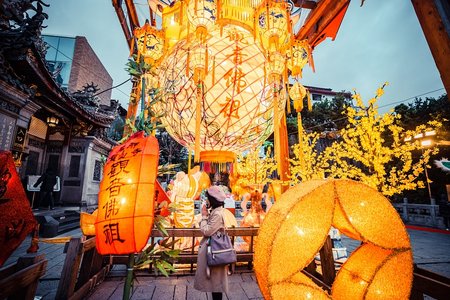
Because of its domestic origins, we can say that Christmas in China does not have a long tradition like in many Western countries, but it has nevertheless undergone significant evolution, reflecting cultural and social influences over the years.
This holiday has its roots in the spread of Christianity in China. The first Christian missionaries, who arrived in the Land of the Dragon between the 1st and 7th centuries, brought the celebration of Christmas with them, but the practices and celebrations were limited to small Christian communities scattered here and there.
It was during the 19th century that Christianity began to gain popularity, particularly through missions and trade. Christmas began to be associated with social and cultural events, rather than religious celebrations: if you think about it, this is also the case today in most places around the world where it is celebrated.
How is Christmas Celebrated in China?
So how is Christmas actually celebrated in China?
Mostly, with decorations. In recent years cities have filled their streets and shops with Christmas trees and twinkling lights, and shopping malls dress their windows to pull customers in. Santa Claus is everywhere, along with reindeer and the rest of the familiar cast. Trees appear in homes and shops too.
It's also big business. Stores run Christmas promotions and discounts, and people spend - on themselves as much as on gifts for others.
Young people in particular organise parties and dinners with friends and family. Presents are exchanged, games are played, Christmas music plays in the background. Some cities host concerts and public events. But remember that 25 December is a normal working day in China, so everything happens in the evening once work is done.
This is all quite recent. In the early 20th century, Christmas in China was a religious occasion, confined to churches and Christian communities. Everything changed from the 1980s onwards, as the country opened up and Western culture arrived. Shops spotted the opportunity, and marketing did the rest.
Today the holiday is a commercial event first and a religious one a distant second - not so different, in truth, from Christmas at home.
Christmas in China: Typical Holiday Dishes
Since it's not a local holiday, there aren't any specific traditional dishes for Chinese Christmas. However, as the custom of gathering for sumptuous dinners with friends and loved ones has developed and spread, so has the custom of preparing special foods and dishes that combine Chinese and Western influences during the holidays.
The most widespread tradition is the one practiced in southern China, which involves the preparation of tangyuan (湯圓), the typical glutinous rice balls. White or colored, plain or filled with black sesame paste, flavored with red wine or cooked in a hot soup, they were originally created to be eaten during the Lantern Festival. In various regions, however, they have begun to be associated with the entire Chinese New Year holiday period, as well as with the Dongzhi Festival (celebrated between December 21st and 22nd) and Chinese Christmas.
In northern China, however, it's common to prepare Jiaozi (饺子) on Christmas Day. These are a very popular type of Chinese dumpling, filled with meat, vegetables, or a combination of both. They can be steamed, boiled, or fried, and are often served with soy sauce or vinegar for dipping.
As we've mentioned, however, during Christmas Day in China, there's a tendency to mix traditional Chinese dishes with the traditional Western preparations reserved for the holidays. Therefore, during this dinner, you might also find foods such as:
- Christmas cakes, often decorated with cream, dried fruit, and chocolate. They may include variations such as green tea or fruit cakes;
- Holiday Cookies, decorated, and Christmas cookies. Gingerbread cookies are a classic, becoming increasingly popular in China as well. They're often made to be shared among friends and family.
- Pizza and hamburgers , or more generally Western food served in restaurants and fast food joints. It's common to eat it during Christmas celebrations, especially in large cities, as a way to feel more Western.
- Traditional Chinese Foods: Traditional dishes such as spring rolls and dumplings can be included in Christmas meals, representing Chinese cuisine.
- Rice and hot soups : These are always common, and can be served to add comfort to the meal.
- Meat dishes, roasts and stews. Some families traditionally prepare these dishes for Christmas dinner, combining local influences with Western recipes.
- Local and traditional Chinese sweets, such as mooncakes or other glutinous rice-based desserts, even if they are not specifically created for Christmas.
Furthermore, on Christmas tables in China, it's common to find a rich assortment of fresh fruit, especially local varieties of oranges, apples, and persimmons, which symbolize prosperity and good luck. It's also common to give fruit to one another as gifts, especially apples due to their symbolic meaning.
During celebrations, it is common to serve drinks such as tea, wine, champagne, or beer, to toast meals and accompany the various dishes with the appropriate beverage.
In conclusion, we can define Christmas in China as a celebration that has evolved over the years , taking on a primarily commercial and social rather than religious significance.
Although it is not a traditional holiday and is not recognized as an official public holiday, Christmas is gaining increasing popularity, especially among young people and in urban areas. Cities are adorned with twinkling lights and Christmas decorations, while stores offer discounts and special promotions to attract consumers and encourage them to spend money on gifts, trees, and lights.
While the cultural and religious roots of Christmas in China may differ from those in other parts of the world, the holiday continues to grow and adapt, reflecting China's dynamic society and the influence of global traditions.
Over time, Christmas in China may increasingly take on its own unique identity, integrating local and international elements into a fascinating fusion of cultures. If you happen to be in China during the holiday season, you certainly won't miss the traditional atmosphere!
Summary
Christmas in China is not a public holiday and has little religious weight, since the country's traditions are Confucian, Taoist and Buddhist and Christians are a small minority. Instead it has become a bright commercial and social occasion, strongest in the cities and among the young: decorated streets and malls, Christmas sales, parties in the evening, and the charming home-grown custom of giving "peace apples" on Christmas Eve. It is a fascinating example of a global festival taking on a local character, and a wonderful thing to witness on a Chinese course with SPRACHCAFFE in Beijing.
FAQ
Christmas is not a public holiday in China and has no religious tradition there, but it is celebrated in cities as a commercial and social occasion. Shops, malls and young people mark it with decorations, gifts and nights out.
On Christmas Eve, known as "Ping'an Ye" (peaceful evening), many Chinese give beautifully wrapped apples called "ping'an guo", or peace apples. The custom is a pun, because the word for apple sounds like the word for peace.
Celebrations are mainly urban and festive rather than religious: decorated shopping centres, Santa displays, gift-giving among friends, and meals or outings. It is treated more like a fun, romantic occasion than a family holiday.
Related news

Get the latest on travel, languages and culture