
England is the birthplace of the language, which makes it one of the best places to learn or improve your English. One popular way to do it is a stay at an English college in England, where lessons, comfortable accommodation and an international student community come together in one place. This guide explains what a college stay offers, how it compares with other options, and what to look for when you choose, so you can find the right fit.
How to Choose an English College in England
What an English college stay offers

At a residential college you live, study and socialise on one campus, often in a historic building with good facilities.
The appeal is threefold: comfortable accommodation and full board in one place, constant contact with students from around the world, and genuine immersion, since you are surrounded by English from breakfast to the evening activities.
For many learners that combination makes progress faster and the experience more enjoyable than lessons alone.
Colleges, summer schools and homestays
There is no single best option, only the one that suits you.
Residential colleges and summer schools work well for those who want everything on site and a ready-made social life, and summer courses in particular are a good way to use the school holidays to learn while travelling.
Homestays, where you live with a local host family, suit learners who want more everyday contact with British life and more speaking practice outside class.
Younger students are often best served by a supervised junior programme: SPRACHCAFFE's junior courses are separate from the adult ones, with age-appropriate activities and full supervision, which reassures parents sending a child abroad for the first time.
What to look for when choosing
A few things matter more than the brochure photos:
| What to check | Why it matters |
| Accreditation | In the UK, British Council accreditation is the key mark of quality and is the first thing to look for |
| Qualified teachers | Trained, experienced teachers make the difference to how quickly you progress |
| Class size and mix | Smaller classes with mixed nationalities mean more speaking time and more English outside class |
| Location | City centres such as London put culture and practice on your doorstep; coastal towns such as Brighton add a relaxed, seaside setting |
| Support and pastoral care | On-site support from arrival to departure matters, and proper supervision is essential for junior stays |
Choose your college location



Studying English with SPRACHCAFFE in England

In England, SPRACHCAFFE has schools in London and Brighton.
The London school holds British Council accreditation, the recognised UK quality standard, and puts you in the cultural heart of the capital;
Brighton pairs English lessons with a lively, seaside setting on the south coast.
Both offer courses at a range of levels, from general to intensive and exam preparation, with different accommodation options.
For current course details, dates and prices, see the England course pages or contact the SPRACHCAFFE team.
Summary
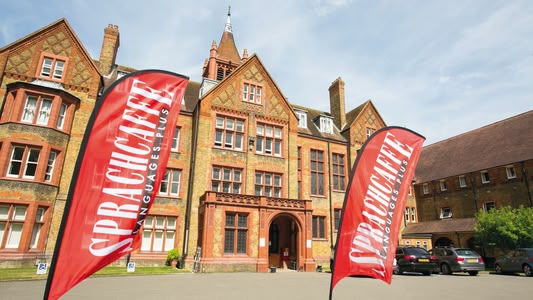
A residential English college in England offers lessons, accommodation and an international community in one place, with real immersion in the language.
Weigh it against summer schools and homestays to find your fit, and when you choose, check accreditation (British Council in the UK), teacher qualifications, class size, location and the level of support, with proper supervision for younger learners.
SPRACHCAFFE's accredited school in London and its Brighton school are two ways to study English in England.
FAQ
Check the accreditation (British Council recognition is the key mark), the range of course levels, average class size, the mix of nationalities and the accommodation options. These decide how much you will actually speak and improve.
A typical stay combines English lessons with accommodation, often a homestay or residence, plus an activity and excursion programme. This mix of study and daily life abroad is what drives fast progress.
Two to four weeks suits most learners for a clear step up, while longer stays of eight weeks or more allow a full level of progress. Even a short, intensive course helps if it is well structured.
SPRACHCAFFE has run language stays since 1983 and combines accredited teaching with immersion in daily life, so learning continues outside the classroom. That mix of Language, People and Experience is the core of every programme.
Related news



Get the latest on travel, languages and culture