
The second-largest country on Earth, Canada pairs vast, empty wilderness, mountains, lakes and forests cover much of it, with friendly, cosmopolitan cities and two official languages. From Banff and Niagara Falls to the street festivals of Montréal and Vancouver, it is a wonderful place to explore, and, as an English- and French-speaking country with a welcoming reputation, a great place to learn a language too. This guide covers the practical essentials and the culture that make a trip work.
Canada Travel Guide
| Capital | Ottawa |
| Largest cities | Toronto, Montréal, Vancouver, Calgary |
| Languages | English and French (officially bilingual) |
| Currency | Canadian dollar (CAD) |
| Head of state | King Charles III (a constitutional monarchy in the Commonwealth) |
| Entry | Visa-exempt visitors need an eTA (apply online before you travel) |
| Best time to visit | Depends on the region; summer is warmest, autumn is scenic |
Geography
Canada stretches across North America from the Atlantic in the east to the Pacific in the west and north to the Arctic, bordering the United States to the south and north-west. It is the world's second-largest country by area and spans six time zones, and much of it is wilderness: forests, lakes and mountains cover a great deal of the land. Its best-known natural attractions include Banff National Park in the Rocky Mountains and Niagara Falls on the border with the United States, and it has more than twenty UNESCO World Heritage Sites.
Time Zone
Canada has many different climate zones as well, because it stretches across such large masses of land. There are areas with polar climate conditions, maritime climate, continental climate and moderately cold climate, which means that there are varying amounts of precipitation and average temperatures.
The best time to travel to Canada is difficult to define because of the different climates. In the Northern parts of Canada temperatures can go all the way down to -40 degrees Celsius in the winter. In summer, on the other hand, temperatures of up to 30 degrees can be expected. The Okanagan Wine Valley is one of the warmest regions in all of Canada, located in the state of British Columbia.
Climate and when to go
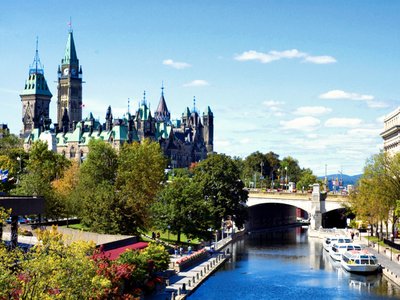
Canada spans several climate zones, from polar in the north to milder maritime and continental climates further south, so the best time to visit depends where you are going. Northern winters can fall to around minus 40 degrees Celsius, while summers can reach the low 30s; the Okanagan Valley in the province of British Columbia is one of the warmest regions. In general, summer (June to August) is the peak season, and autumn brings crisp, scenic weather.
Climate Chart for Ottawa (in degrees Celsius)
| Ottawa | Jan | Feb | Mar | Apr | May | Jun | Jul | Aug | Sep | Oct | Nov | Dec |
| High (°C) | -4 | -2 | 3 | 12 | 20 | 26 | 27 | 27 | 22 | 15 | 7 | -1 |
| Low (°C) | -14 | -13 | -8 | 1 | 7 | 13 | 15 | 14 | 9 | 3 | -3 | -10 |
| Vancouver | Jan | Feb | Mar | Apr | May | Jun | Jul | Aug | Sep | Oct | Nov | Dec |
| High (°C) | 6 | 8 | 11 | 14 | 18 | 22 | 23 | 23 | 19 | 14 | 10 | 7 |
| Low (°C) | 1 | 0 | 3 | 5 | 8 | 11 | 12 | 11 | 10 | 7 | 4 | 2 |
Climate Chart for Vancouver (in degrees Celsius)
| January | February | March | April | May | June | July | August | September | October | November | December | |
| Highest temperatures | 6° | 8° | 11° | 14° | 18° | 22° | 23° | 23° | 19° | 14° | 10° | 7° |
| Lowest temperatures | 1° | 0° | 3° | 5° | 8° | 11° | 12° | 11° | 10° | 7° | 4° | 2° |
| Hours of sunlight per day | 2hrs | 3hrs | 4hrs | 6hrs | 7hrs | 7hrs | 10hrs | 8hrs | 6hrs | 4hrs | 2hrs | 1hr |
| Water temperature | 9° | 8° | 8° | 9° | 11° | 13° | 14° | 15° | 13° | 12° | 11° | 8° |
| Rainy days | 15 | 14 | 14 | 11 | 9 | 7 | 5 | 5 | 8 | 12 | 17 | 17 |
Requirements for Entering Canada
All non-visa applicants must apply for an online-based travel authorization, the "eTA" (Electronic Travel Authorization), prior to departure. We recommend completing the application up to 72 hours prior to departure.
In case of later applications, timely processing of the application by the Canadian authorities cannot be guaranteed. The cost is 7 CAD per person. The "eTA" is valid for 5 years.
The application requires a valid passport, an e-mail address and a credit card (Mastercard, Visa, American Express) to pay the fee. The online form is currently only available in English or French.
Currency
The currency is the Canadian dollar (CAD, symbol $). Cards are widely accepted, and it is worth noting that displayed prices usually exclude sales tax (see below), which is added at the till.
Healthcare

Canada has a very good health care system and offers sufficient medical facilities and trained specialists.
Hospital fees for foreign visitors are either calculated according to daily rates or according to the specific illness and the duration of the hospital stay, but can usually be very high. Before you travel, you should therefore make sure that your health insurance policy also covers non-European countries or take out appropriate travel health insurance.
TIP: Pay by credit card, take the bill with you and submit it to the insurance company later at home. Saves both you and the hospital staff a lot of time and stress!
West Nile fever season begins in June. This flu-like viral illness is transmitted by mosquitoes. Since severe complications can occur with the disease, special protection against mosquitoes is recommended during this time. Otherwise, standard vaccinations are sufficient for a trip to Canada. The meningitis vaccination is one of the standard ones in Canada and is one recommended ones to do before travelling.
Packing Checklist
We have compiled a packing checklist so that you can be perfectly prepared for your journey!
Religion
Canada is a country without an official national religion. Three quarters of the population are Christian, the rest are Muslim, Jewish, Hindu, Buddhist. Up to 16% do not belong to any denomination.
Politics
Officially, Canada is a constitutional monarchy part of the Commonwealth of Nations with Queen Elizabeth II as head of state. However, Canada is also a representative parliamentary democracy organized as a large federal state. The constitution is composed of written legal sources and unwritten common law.
Local Language and Communication
There are two official languages: English and French. According to the Charter of Rights and Freedoms, the Official Languages Act and the Official Languages Regulations, bilingualism is officially established. All citizens can use federal services of any kind in English or French. Canadians are known to be very friendly and polite.
One should use the words "please" and "thank you" as often as possible. As a greeting, one is often addressed with "Hi, how are you?". You don't have to answer honestly, a casual "I'm fine, thanks. And you?" is quite sufficient.
Public Transport
In the east of the country, the main traffic route runs along the Saint Lawrence River through Ontario and Quebec, connecting the major cities of Toronto, Montreal, Quebec and Ottawa. The entire north is hardly accessible because it is not needed. In the west, the major cities near the American border are connected by transportation systems.
The Canadian government wanted to connect the widely separated provinces, and this was done with the help of three transcontinental railroads and several spur railroads. For longer distances, there are domestic flights offered by 75 different airlines.
History
Native Americans were the first inhabitants of Canada around 12000 BC. After them, the Inuit came into the land around 5000 BC. Vikings were the first Europeans to live on this land, also known as Newfoundland, in 1000 BC. The Frenchman Jacques Cartier first claimed ownership over regions of Canada in 1534. These regions then became French land. The city Québec was founded by Samuel de Champlain in the 16th Century. Many French people then began to migrate to Canada and create settlements in the years to come. British settlers also came to the land in 1670.
After a few peaceful centuries, the Seven Years War between the English and the French began. In 1763 France gave their ownership rights to Great Britain with the Treaty of Paris. After the U.S. War of Independence (1775-1783), Canada experienced the first wave of immigration of British Loyalists. From 1812 to 1814 followed the British-American War, which ended inconclusively and was concluded with the Peace of Ghent.
In 1867, Canadian Confederation occurred and Canada was declared a federal state by Great Britain, which now had autonomy from Great Britain. By 1912, all provinces (except Newfoundland in 1949) had joined Confederation. Canada voluntarily became a member of the Commonwealth in 1931.After World War II, Canada experienced a large wave of immigration from Europe, India, the Far East, and the Caribbean, which resulted in a significant economic boom. Land treaties were signed with the aborigines, who got back parts of land in the north. There were also tensions between English-speaking Canada and the French province of Quebec, which demanded more independence. However, this was rejected by a narrow majority.
Festivals in Canada
Events in Calgary
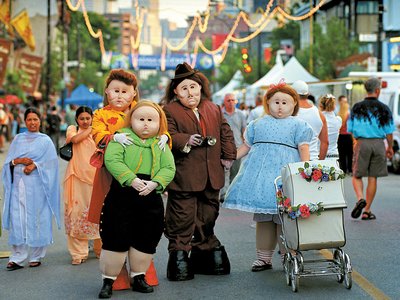
International Festival of Animated Objects: (January) Every year Calgary hosts the International Festival of Animated Objects, celebrating masks, puppets and animated objects. Artists present their creative and original creations, everything from puppets, figures, scenery and stories. For a week, visitors can also attend theatrical performances and workshops.
Calgary Comic and Entertainment Expo: (April) If you are a fan of anime, sci-fi, fantasy, gaming, animation and horror, then this is exactly the event for you! This fair has been around since 2005 and is held annually for 3 days.
Funny Fest Calgary Comedy Festival: (May - June) Calgary's Comedy Fest presents stand-up comedians, musical comedy and a whole range of other entertaining performances. In addition to the performances, visitors can also attend workshops and seminars where they will be introduced to the secrets of the art of comedy.
Taste of Calgary: (August) The most appetizing festival in Canada is called "Taste of Calgary": if you want to taste culinary specialties of the region, this is the place to be! For $1 each, you can taste your way through numerous delicacies. In addition to the food and drinks, there is also a diverse program of live music.
Calgary International Film Festival: (September - October) Every film enthusiast's paradise! For 12 days, a total of 200 films of various genres from 30 countries are shown. In addition to the films, there are also gala events and the opportunity to look behind the scenes.
Events in Montréal
Igloofest: (January) Are you a fan of electronic music? Then you cannot miss Igloofest in Montréal! The festival takes place at an igloo village with music from local and international DJ's and a snowsuit competition!
Montréal En Lumière: (February-March) At this festival you can expect not only a winter wonderland with a ferris wheel, but also light shows, performances, a long zipline and great culinary highlights. But the best thing has to be the Nuit Blanche, an incredible art night with over 200 free events.
Fireworks Festival: (June) L'International des Feux Loto-Québec is an international fireworks competition in which major companies showcase the latest techniques and innovations in the field of pyrotechnics. The park itself also offers a lot of entertainment: with a huge range of music, dance and theater shows, sporting events and leisure activities, getting bored is impossible!
Just for Laughs Festival: (July) Looking for a good laugh? The world's largest comedy festival has been held in Montréal every year since 1983. A selection of the best-known comedians and newcomers perform here under the motto "Make People Happy".
International Jazz Festival: (September) The annual jazz festival attracts more than 2 million visitors. Every year about 3000 artists perform and more than 650 concerts are there to entertain you. Many of these concerts can even be attended for free!
Events in Vancouver
PuSH International Performing Arts Festival: (January - February) For 20 days, audiences from all around the world can attend theater, dance and music performances by international and national artists in and around Vancouver. The PuSH Festival consists of a total of 150 unmissable performances!
Cloverdale Rodeo & Country Fair: (May) Rodeos are one of the biggest traditions in Western Canada. The world's best cowboys and cowgirls show off their impressive skills for an amazing set of events. The Country Fair offers entertainment especially for families with go-karts, petting zoo, country music and many other activities.
International Jazz Festival: (June - July) Jazz lovers will get their money's worth at this festival. With the motto "For the Love of Jazz", this festival offers high-quality concerts and promotes creative, improvised music. Outside the festival season, concerts are also held regularly at Frankie's Jazz Club.
Food Cart Festival: (August) Want to try typical Vancouver food? The Food Cart Festival is a weekend-long event that gives you the opportunity to experience the culinary culture of Vancouver and beyond. During the festival you will experience all you can eat menus, cocktail and beer gardens, live music as well as long table dinners. The highlight of the festival is definitely the Street Food Showdown in the Olympic Village.
Eastside Culture Crawl: (November) 25000 visitors come to the Cultural Crawl every year, to see designs and crafts made by over 480 artists and crafts people. The goal of this festival is to promote and support the artists, whilst also creating further public awareness of these arts by hosting various workshops and seminars about them. This Festival is also completely free of charge!
Events in Ottawa
Winterlude: (January to February) Winterlude is a free yearly festival that attracts about 600000 visitors every year. Must do winter pleasures such as tube sliding, skating and admiring snow and ice sculptures share the spotlight with a cultural and culinary program.
Tim Hortons Ottawa Dragon Boat Festival: (June) This is the largest Dragon Boat Festival in North America with over 200 teams, 5000 paddlers and 75000 audience members and viewers. Concerts and cultural performances also occur during this festival.
Tulip Festival: (May) The Tulip Festival is one of the most exciting and popular events for flower lovers, with more than 3 million tulips to be admired. During your visit you will experience an incredibly diverse selection of flower exhibitions as well as artistic installations, culinary experiences, interactive family programs, breathtaking fireworks, historical military demonstrations and guided tours of the tulip fields.
Events in Victoria
Victoria Canada Day: (July) Every year on July 1st Canadians get together to celebrate the foudning of the country. With live music on various stages, family-friendly events and a great fireworks display, Canada's birthday is an event not to be missed!
Rifflandia Festival: (August) Rifflandia is a 4-day music festival that takes place between the last weekend of August and the last weekend of September at the Royal Athletic Park. During the festival zou will be able to see over 300 artists at more than 10 different venues! Due to the eccentric program and the different venues and shows, the festival attracts thousands of people every year.
Dragon Boat Festival: (August) The Dragon Boat Festival has been held every August for the last 20 years. But don't worry if you don't make it to Canada for August, the dragon boats can be seen in the harbor already from February because of their growing popularity. During the festival visitors can also enjoy the Festival of Lights, the beer garden, or the "Eye Dotting Ceremony".
Fringe Festival: (August-September) Every summer Victoria hosts the Fringe Festival. Visitors can look forward to live performances from around the world. This event features an electric mix of spoken word, drama, musicals, dance, comedy, magic and theater.
International Chalk Art Festival: (September) The largest street art festival in Canada showcases the cultural diversity of Downtown Victoria at the port of Victoria. You can admire chalk artworks (even in 3D!) made by professional artists for free. You will also be able to enjoy live music outdoors whilst viewing the artists' work.
Holidays
- The Monday before or on May 24 is Victoria Day (Fête de la Rein), celebrating the birthday of the reigning British monarch
- July 1 is Canada Day (Fête du Canada), commemorating the formation of Canada as a state of the British Commonwealth by the British North America Act on July 1, 1867
- The first Monday in August is Civic Holiday (Premier lundi d'août)
- The first Monday in September marks Labor Day (Fête du travail)
- The second Monday in October marks Thanksgiving (Action de grâce). On this day, Canadians, just like the U.S., celebrate how the Pilgrim Fathers landed at Plymouth Rock and were welcomed by the Wampanoag Indians and feasted together.
- On November 11, the day of the armistice in World War I, Canadians celebrate Remembrance Day (Jour du Souvenir). It is intended to commemorate the war veterans.
Food
A wide range of culinary delights awaits you in Canada! The Atlantic coast is known for its lobster and lobster-like crustaceans, while the west coast used to specialise in wild salmon fishing, now replaced by salmon farming. Cultural differences also deeply influence Canadian cuisine. In Québec, the French influence cannot be overlooked. In the prairie provinces, on the other hand, the influence of the midwestern United States is strongly noticeable, with the British culinary traditions mainly influencing the far west.
There are also wine-growing regions in Canada, for example on the Niagara Peninsula and in the Okanagan region, as well as in the southeast of Vancouver Island in British Columbia. Viticulture has a tradition dating back more than 200 years. In 1974, new viticultural licenses were issued and wine associations focused on higher quality, resulting in an increased popularity. Canadian wines contribute to about half of the country's total consumption.
Practical tips
A few things are worth knowing. Sales tax (a federal GST of around 5%, plus provincial taxes in most provinces) is usually added at the till, so displayed prices look lower than what you pay, this applies to restaurant menus too. Tipping is expected in restaurants and taxis, customarily around 15 to 20%. Alcohol may be bought and drunk by those aged 19 and over (18 in Alberta, Manitoba and Québec), and drinking in public is not allowed. And if you camp, note that wild camping is restricted in national parks, and in bear country you must store food securely, in odour-proof containers in the car or hung at least four metres up a tree.
Summary
Canada offers wilderness and cosmopolitan cities in one enormous, welcoming package: Banff and Niagara, the festivals of Montréal, Vancouver and Ottawa, and food from Atlantic lobster to Okanagan wine. Sort your eTA and travel insurance in advance, remember that tax is added at the till, and choose your season by region. Best of all, as an English- and French-speaking country, Canada is a superb place to learn a language, on a course with SPRACHCAFFE in Canada.
FAQ
Summer suits the cities and national parks, autumn brings spectacular foliage, and winter offers world-class skiing. The best time depends on whether you want hiking or snow.
Both. English is the majority language across most of the country, while French is the main language of Quebec, and Canada is officially bilingual at the federal level.
Given its size, domestic flights link distant regions, while trains, long-distance buses and rental cars serve shorter routes. Cities have good public transport.
A language course in Canada immerses you in one, or both, official languages.
Related news
Get the latest on travel, languages and culture