
Talking about where you live is one of the first things you do in a new language, so a good stock of house vocabulary is worth building early. This guide gives you the words for the main types of home, the parts of a house and its rooms, and the adjectives to describe them. Each word comes with a short explanation, and the British and American differences are noted wherever they matter.
How to Describe a House in English
Types of home in English
English has a word for every kind of dwelling, and most of them describe how a home sits in relation to its neighbours. The terms below lead with British usage, noting the American equivalent where it differs.
| Type | What it is |
|---|---|
| House | A standalone building designed as a home for one or more people |
| Flat (US: apartment) | A self-contained home occupying part of a larger building, sharing hallways and stairs |
| Terraced house | A house in a row, joined to its neighbours on both sides by shared walls |
| Semi-detached house | A house joined to one neighbour by a single shared wall, usually mirror-image |
| Detached house | A standalone house with no shared walls |
| Bungalow | A house on a single storey, with all rooms on the ground floor |
| Cottage | A small, traditional house, often in the countryside |
| Penthouse | A luxury flat on the top floor of a tall building |
The parts of a house
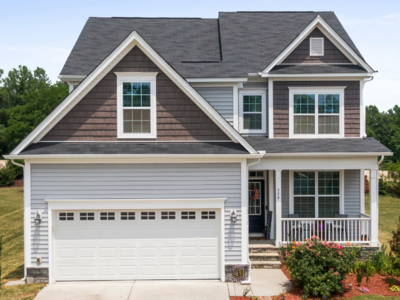
Start at the street. The private path from the road to the house or garage is the driveway, and the small covered area in front of the door is the porch. In American English a porch is usually something larger, a seating area running along the front of the house. Above you, the roof is tiled or slated in most British homes, with a chimney carrying smoke up from the fireplace and a gutter along the edge to take the rainwater away.
Inside the front door is the hallway, often just called the hall, which connects the ground-floor rooms. The stairs lead up from it, and the flat area at the top, where the bedroom doors open, is the landing. That one is worth learning early, because it comes up constantly and almost never appears in vocabulary lists. An upstairs room may also open onto a balcony, a platform with a railing outside a window or door.
Visit England, learn English


The rooms of a house
Downstairs you will usually find the living room, the main room for relaxing and sitting together, which British speakers also call the lounge or the sitting room. Beside it are the kitchen and, in larger homes, a separate dining room used only for eating. A utility room is a small space off the kitchen for the washing machine, the ironing and storage, and a study, or office, is where you work or read.
The word to be careful with is bathroom. In many British homes the toilet is a separate little room, so a bathroom means the room with the bath or shower in it. In American English, a bathroom always includes the toilet. A bathroom attached directly to a bedroom, with no door to the hallway, is an en suite.
Above and below the main floors, the space under the roof is the attic, usually called the loft in Britain while it is unconverted, and the floor below ground level is the basement, or a cellar if it is used only for storage.
Adjectives to describe a house
Adjectives are what turn a list of rooms into a description. A home that is spacious is larger than you would expect, as in "the flat is surprisingly spacious for the city centre". One that is cosy is small but warm and comfortable, though in property adverts cosy is mostly a polite way of saying small, just as charming often means old.
Bright means a room gets plenty of natural light, and airy that it feels open and easy to breathe in, usually thanks to high ceilings. Open-plan describes rooms that flow into each other with no dividing walls, which Americans call open-concept. Period means built in a recognisable historical style and kept that way, and well maintained means in good condition and clearly looked after.
How to practise
The best way to fix this vocabulary is to use it.
Describe your own home out loud, room by room, naming the rooms and the parts as you go, then write a short description of five or six sentences and read it aloud.
Reading real property adverts in English is the other shortcut, since they use these words densely and repeat the same phrases.
Summary

To describe a house in English you need three sets of words: the type of home (flat, terraced, semi-detached, detached, bungalow, cottage), the parts and rooms (hallway, stairs, landing, living room, kitchen, bathroom, attic), and the adjectives that bring it to life (spacious, cosy, bright, airy, well maintained).
Watch the words that shift meaning between Britain and the United States, above all flat and apartment and what counts as a bathroom.
Then practise by describing your own home out loud, room by room. Better still, practise it in person on an English course with SPRACHCAFFE.
FAQ
The main types are the house, the flat, the terraced house, the semi-detached house, the detached house, the bungalow, the cottage and the penthouse. Most of these terms describe how a home is joined to its neighbours, which is why terraced, semi-detached and detached come up so often in Britain.
A flat and an apartment are the same thing. "Flat" is the usual British term and "apartment" the American one, though British speakers also use "apartment" for a larger or more upmarket property.
You need the type of home, the parts of the house such as the driveway, porch, roof, hallway, stairs and landing, the names of the rooms such as the living room, kitchen, bathroom and attic, and adjectives such as spacious, cosy, bright and well maintained.
In British English, a bathroom is the room containing the bath or shower, and the toilet is often a separate little room. In American English, a bathroom always includes the toilet.
Describing your own home out loud, room by room, builds this vocabulary quickly, and reading property adverts in English adds natural phrasing. A course abroad gives constant practice, because you use the words in conversation every day.
Related news

Get the latest on travel, languages and culture