Language Learning Statistics

Learning a new language can take up between 600 and 2200 hours.

Yet, in a growing, globalized world, the ability to communicate between people from different countries has become one of the most important skills of the 21st century. And with the ongoing rise of Large Language Models, transforming how languages are learned, the language learning business has been more relevant than ever.

The following article explores the size of the global language learning market, the world's most popular languages, the role of bilingualism in shaping society, and how language learning may evolve in the future.


How big is the language learning market right now?

Grand View Research - the Numbers :

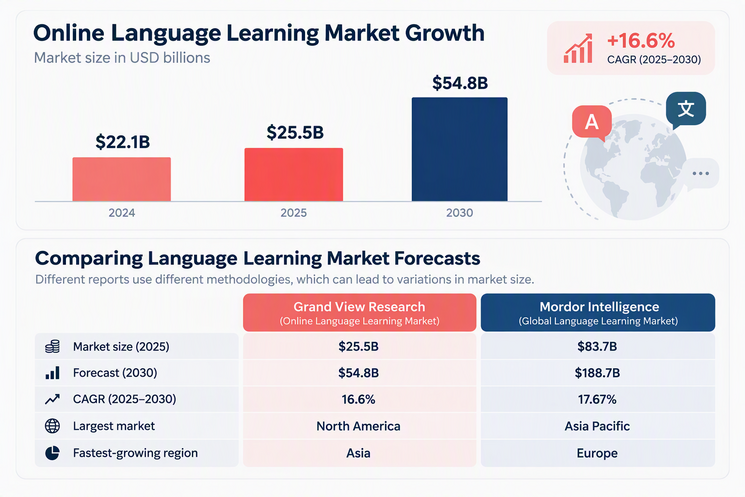
$22.1B: online language learning market size in 2024

$25.5B: estimated market size in 2025

$54.8B: projected market size in 2030

According to Grand View Research, the global online language learning market was valued at around $22.1 billion in 2024 and is projected to reach $54.8 billion by 2030. The market is expected to grow at a Compound Annual Growth Rate of 16.6% between 2025 and 2030.

Mordor Intelligence - The Numbers:

$83.7B: global language learning market in 2025

$188.7B: projected market size in 2030

17.67%: expected CAGR from 2025-2030

Mordor Intelligence estimates that the global language learning market will grow from $83.65 billion in 2025 to $188.70 billion by 2030, representing a compound annual growth rate (CAGR) of 17.67%.

According to Grand View Research, North America is the largest market in online language learning, with over a 36.0% share in 2024, while Asia is the fastest-growing market. In contrast, Mordor Intelligence claims that the Asia Pacific Market is the biggest, while Europe is the fastest-growing market. Grand View Research's market share is calculated based on online subscriptions, whereas Mordor Intelligence views language learning more broadly.

How many people are learning a language right now?

The most spoken languages in the world right now are English, Mandarin, Hindi, and Spanish[1]. Statista also ranks Arabic, French, Bengali, and Portuguese. Russian, Indonesian, Urdu, and German end the list of the 12 most spoken languages in the world. English leads the ranking with around 2.3 billion active speakers[2], while Mandarin follows with 1.2 billion and Hindi with around 600 million.

According to ScienceDirect, learning a language refers to the process of acquiring a language beyond one's native tongue, involving both cognitive processes and social interaction. But what are the languages that are being learned the most?

The Numbers

1.5B People currently learning a foreign language

154 Countries where English is the most learned language on Duolingo

43% Preply users learning English

According to Berlitz, around 1.5B people are currently learning a foreign language; however, there are no clear statistics on how many people are learning a language. According to Kent State University, English is the most learned language, followed by German, Spanish, French, and Swedish. Another popular language-learning platform, Duolingo, also ranks English as the most learned language in 154 countries in its 2025 language report. The most learned languages on the app are Spanish, French, Japanese, German, Korean, Italian, Chinese, Portuguese, and Hindi. Interestingly, Japanese took over German for 4th place, and Korean overtook Italian for 6th place, showing rising interest in Japanese and Korean culture.

Looking at Preply, English tops the list with 43% studying it as a second or additional language, followed by Spanish (13%) and French (8%), then German (5%) and Arabic (4%). Preply frames the motivations behind these choices as: English for career and global job access, Spanish for the Americas and increasingly Europe, French for academic and professional contexts, German tied to higher education and research, and Arabic's growth linked to migration, religion, and business ties. These statistics are also backed up by online research that marks English as the most searched language on the web in 2023.

English Language Learning Statistics

2.3B English speakers worldwide

380M Native English speakers

1.1B+ English speakers who learned it as a second language

English remains the most widely spoken and learned language in the world, with studies suggesting over 1.75 billion speakers globally[3]. Notably, while English has around 380 million native speakers, over 1.1 billion people have learned it as a second language. In contrast, Mandarin has nearly 1 billion native speakers and only around 190 million language learners.

Why is English the Global Language?

  • English dominates the internet: According to Statista, around 49% of all web content is in English, as of October last year. This makes English an important gateway to information, entertainment, and communication online.
  • The most popular language to learn: English consistently ranks as the most popular language to learn on major language-learning platforms in most countries. It is also widely used for online content, exams, and professional certifications, making it useful well beyond the classroom.
  • English matters for employment: English skills can also influence job opportunities and starting salaries. Among employers in 38 countries, 98.5% assess candidates' English skills, while 50% offer better starting packages to people with strong English proficiency.
  • A language for global opportunities: English remains widely used in business, higher education, travel, and digital media. Many employers now consider English proficiency a basic workplace skill, while universities around the world often require standardized English test scores for admission.
  • More than a school subject: Because of its role in education, employment, travel, and access to information, learning English has become more than just a school requirement. For millions of people, it is an investment in better career opportunities, greater international mobility, and access to information.
  • A growing market: The demand for English is also reflected in the size of the industry. The global English learning market is expected to reach more than $70.7 billion by 2030[4], showing the continued worldwide demand for English-language education.

We have discussed the financial benefits of multilingualism in this article here!

How Does Language Learning Differ Between Europe and the US?

Europe vs. US: Key Takeaways

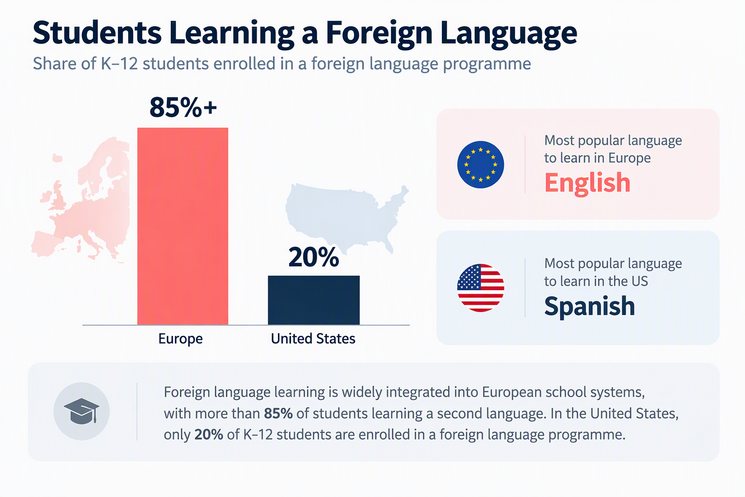
  • Students learning languages: 85%+ in Europe vs. 20% in the US[5]
  • Most popular language: English in Europe vs. Spanish in the US[5]
  • School requirements: Foreign languages are widely required in Europe vs. no federal requirement in the US
  • Main reason: Europeans need English (and other languages) for travel, study, and work, while Americans have less need because English is already a global language[6]

In the European school system, English is by far the most widely taught first foreign language, followed by French, German, and Spanish[5]. More than 85% of students from kindergarten through 8th grade currently learn a second language. In contrast, only 20% of K-12 US students are enrolled in a foreign language program. Spanish is by far the most popular language to learn in America, far ahead of French, German, Latin, Chinese, Japanese, and other languages. However, these numbers vary by state. For example New Jersey and DC have the highest share of K-12 students enrolled in a foreign language, at 51.18% and 47.17%, respectively. In contrast, other states report single-digit enrollment.[7]

Where They Differ

This transatlantic contrast shows that the European school system places heavy emphasis on multilingualism, whereas the American school system focuses on Spanish in its curriculum. According to the European Union, foreign‑language proficiency is a core outcome, as each pupil should have at least one foreign language during school life. The language-learning framework is embedded in the curriculum and mandatory, whereas in the U.S., there is no federal mandate for foreign‑language study. Only a minority of states require students to study a foreign language to graduate from high school. In many states, students can also meet the requirement by taking other subjects, making foreign languages seem less essential. Because English is perceived as the global language, this lowers the perceived necessity of learning an additional language. In contrast, most European countries operate with non‑global national languages, so English and other regional languages are seen as essential for higher education, mobility, and employment[8]. Other reasons for the lack of language learning in American schools are budget pressures and scheduling constraints, as well as a national shortage of qualified language teachers[9].

How are Apps and AI Changing Language Learning?

Apps & AI in Language Learning: Key Takeaways

  • Duolingo users: 500M worldwide
  • Teachers using AI: 75% of surveyed English teachers[10]
  • Main uses of AI: 57% for teaching materials vs. 53% for learner practice[10]
  • For the best result: Combing Apps with human teachers

Duolingo's 500 million users show that language learning apps have moved from niche experiments to core components of how millions of people learn new languages. Grand View Research names Duolingo, Babbel, Busuu and Preply amongst the most used language learning apps. The market has grown from 6-11 billion USD in the mid‑2020s and is expected to reach around 24-44 billion USD by the early‑to‑mid 2030s[11]. The reasons for this drastic increase are clear: while Large Language Models still dominate the global market, language-based apps promise personalized pacing, immediate feedback, and scalable practice opportunities. Through conversational chatbots, speech‑recognition tutors, and generative writing assistants, the learning experience should feel tailor-made to the student. It is also worth noting that not only students, but teachers are frequently using artificial intelligence in the classroom. A 2024 British Council survey of 1,348 English teachers across 118 countries found that 75% already use AI tools. The most common uses are creating teaching materials (57%), providing learner practice (53%), and planning lessons (43%)[12].

Will AI Change Language Learning?

Whether language-learning apps will eventually replace or surpass traditional language education is widely debated. While there is no clear answer yet, studies suggest that both approaches have their strengths. Apps can be more effective in some areas, while traditional classroom learning still outperforms them in others. According to studies, Mobile-Assisted Language Learning Applications can be at least as effective, and sometimes more so, for certain language outcomes. A study from the University of Sheffield suggested that app‑only learners outperformed classroom learners on general L2 proficiency and receptive vocabulary, while classroom learners improved more in listening skills. For speaking, listening, and retention, human teachers remain the most effective way to learn a language, as studies with human tutors showed higher gains in spontaneous speaking, pronunciation accuracy, and confidence in unscripted conversation. Therefore, multiple studies highlight the benefits of combining app use with teacher-led instruction. Practicing daily with AI-powered apps while seeing a teacher weekly tends to have the most positive effect on language learning progress.

The Future of Language Learning

With emerging technologies and the growing role of artificial intelligence in our everyday life, the future of language learning is likely to be digital. As the language-learning market continues to grow, skills such as bilingualism are likely to become increasingly valuable in the workplace, especially as we live in an ever more interconnected world.

The future path to language learning will likely be a hybrid of apps with personalized language paths, routine tasks, and individual feedback. In contrast, in-class learning methods will feature human teachers focusing on interaction, cultural context, and critical thinking.

Language loss is also likely to continue. According to Ethnologue, there are 7,170 languages in use today. However, the top 20 languages worldwide, which make up only 0,3% of the world's languages, are spoken by half of the globe, actively endangering thousands of languages. UNESCO links the rise of AI language-learning technologies to a danger for endangered languages, arguing that these tools could accelerate the dominance of already-major languages at the expense of smaller ones. While technological progress has advanced language learning, it can also be a threat. For language learning, technology will continue to be a tool that shapes how we learn and use languages.

Get the latest on travel, languages and culture
captcha